
Royal Albert Hall
Kensington Gore, Kensington, London SW7 2AP 020 7589 8212
- Where to buy tickets
- Best seat advice
- Seating plan/s
- Getting to the theatre
Buying tickets online
www.royalalberthall.com, their own site provide the service for this venue.
The Albert Hall site allows you to select actual seats yourself from those available at most performances (for a few, it still only allocates "best available" automatically). It also allows you to view photographs of the auditorium from various blocks, giving some idea of the view - an excellent feature, feels the monkey. Simply follow the link on their site from their "seating plan" diagram.
Note when booking online that the system will display a confirmation page with the first line giving section letter and row number. This number should not be confused with the "section half" numbers - either a 1 or a 2 - that the Albert Hall use to split each section for administrative efficiency.
A reader tip:
" I would say buy your tickets through the Albert Hall directly. The website's 'pick your own seat' function is very helpful, equally the box office assistants on the phones.
If you buy through an agency they are more than likely not to know the complex layout of the building and put you in seats that you won't be satisfied with.
Also, a little inside tip here, if you buy a ticket through the hall and on the night you wish to upgrade, you will only have to pay the difference in price between the tickets. However if you buy an agency ticket and try to do the same, you'll have to buy a completely new ticket at full price."
Booking fees per ticket for online bookings:
10% of the total transection is charged, plus £2 restoration levy is usual - though it varies by event. The BBC Proms charge 2% plus £2 per ticket to a maximum of £25 on the per ticket part of the bill. The system will advise at time of booking. This covers credit card costs, postage and the printing cost of the highly ornate tickets produced. Theatremonkey thinks this fee is high.
Other Online Choices (with genuine S.T.A.R ticket agencies):
Independent S.T.A.R. ticket agencies may also offer an alternative choice of seats for some events. Note, however, that many S.T.A.R. ticket agencies don't sell tickets for pop events at this venue. Details will appear below if appropriate.
Ticket agencies offer an alternative way to buy tickets, with booking fees differing from those charged by the venue box office itself. They may have seats available or special offers when theatres do not.
Ticket agency prices vary in response to venues implementing “dynamic pricing” - which alters prices according to demand for a particular performance. Current prices are advised at time of enquiry.
Box office information
Telephone: 020 7589 8212.
Operated by the venue itself between 10am and 8pm. At other times, and during busy periods, your call may be handled by See Tickets Agency on behalf of the venue.
Booking fees per ticket for telephone bookings:
10% of the total transection is charged, plus £2 restoration levy is usual - though it varies by event. The BBC Proms charge 2% plus £2 per ticket to a maximum of £25 on the per ticket part of the bill. The system will advise at time of booking. This covers credit card costs, postage and the printing cost of the highly ornate tickets produced. Theatremonkey thinks this fee is high.
For personal callers or by post:
Kensington Gore, London. SW7 2AP
No booking fee is usually added for personal callers, but they pay the £2 restoration levy.
Note that the box office is located at Door 12, to the left side of the venue as you look at it from Kensington Gore. It is near the back of the building, so enjoy the walk around, and note the wonderful restoration job too!
A reader tip:
"I would say buy your tickets through the Albert Hall directly. The website's 'pick your own seat' function is very helpful, equally the box office assistants on the phones. If you buy through an agency they are more than likely not to know the complex layout of the building and put you in seats that you won't be satisfied with. Also, a little inside tip here, if you buy a ticket through the hall and on the night you wish to upgrade, you will only have to pay the difference in price between the tickets. However if you buy an agency ticket and try to do the same, you'll have to buy a completely new ticket at full price."
Special Access Needs Customers:
Wheelchair users and other registered disabled theatregoers can book their seats and enquire about concessionary prices that may be available to them on 020 7070 4410. Please note that this number is ONLY for access bookings and is NOT for general public use.
www.royalalberthall.com is the official venue website.
Please remember that cheaper seats often do not offer the same view / location quality as top price ones, and that ticket prices are designed to reflect this difference.
This is an oval auditorium with a stage at one end. Seats in the centre Arena can be removed for 'in the round' events.
- Choir
- Arena
- Stalls
- Boxes
- Circle
- Promenade
Choir
Layout
These rows are behind the stage, facing the rest of the hall.
Legroom
Just adequate for those up to 5ft 7 in the front row, maybe an inch more in rows behind. Seats 34 and 134 in row 9 have nothing in front.
Choosing seats in general
When sold, these offer a cheap and quality (if backward) view of the stage. Choose rows 1 to 3 before 4 to 9.
General hazard notes
When sold, these offer a cheap and quality (if backward) view of the stage. Choose rows 1 to 3 before 4 to 9.
A reader reports that during the Proms season (each summer), "row 1 of the Choir is RESTRICTED VIEW (though with no reduction in price). At the back of the stage there is an LED screen running the whole width of the platform in front of the choir seats. Since the structure that holds the LED screen projects about a foot in front of the parapet and level with its top, it obstructs the view of the upper levels of the stage."
Changes for the current production
None.
Arena
Layout
Variable, but usually up to 32 rows in the centre, flat part of the hall.
Seats are directly in front of the stage, facing it, split into two blocks by a centre aisle.
There is no rake (sloped floor to help see over rows in front) in this area.
Layouts variations include having single seats added / removed at the extreme edges of rows. More radical changes for events that require central staging, like "Cirque du Soleil" each year, see seats reduced to a small crescent in front of a large performing area.
Legroom
Good, as normal chairs are used.
Choosing seats in general
If a tall person is in front of you, tough. Rows 1 to 6 are excellent, 7 to 10 acceptable for those tall enough to see over heads, rows 11 back have a poor value view, and from row 20 back sound suffers too.
For “non standard” layouts, anything more than 10 rows back should be treated with suspicion for the same reasons.
Rows 31 and 32 are often shortened or removed to provide space for a sound mixing desk. This may make row 30 unpalatable for purists - though could have the advantage of the sound being rather good here as the creator is right behind the row...
When seats are removed for the annual promenade concert season, the arena become the perfect place to be for a concert. A reader notes though to, “BE AWARE OF THE PROMMERS (or season ticket holders). These are the extremely dedicated group of concert goers who come to most, or in some cases, all of the proms concerts. They can be quite abrasive and upfront with anyone who isn't part of 'their group'. They will also call upon the stewards for the slightest imperfection. Trust me, you don't want to know how they reacted when the BBC took away 'their' fountain one year to create more space in the arena for the average punters. If it helps, the section they always stick to is from the front of the middle of the arena across to stage right. I would personally suggest staying on the other side and remaining among less highly strung audience members."
General hazard notes
No rake means no view if a tall person is in front. New seats and re-thought offsetting have improved things slightly, but not that much, and if everybody stands up...
Sound quality diminishes from around 20 rows back at some performances. A reader feels,
"The sound system was completely upgraded in 2019 and now sounds great almost everywhere. The only issues I've heard since are in the choir level where on-stage speech can sometimes be a bit echoey and harder to understand than other areas, but otherwise few sound complaints these days other than from specific shows."
In 2023 the monkey still found the sound in the front row poor at one concert.
A sound desk behind the last row may bother some purists.
Prommers, apparently - see above...
Changes for the current production
None.
Readers comments
"Row B. Seat 13 and 14: "Classical Spectacular" (March 2015). This production really was spectacular. The seats in the arena were in a block of four on either side of a platform coming out from the central stage. There were just two rows (A and B) on either side of the platform before the rows going across the whole auditorium behind us. There was a platform on the stage coming into the main arena with just the blocks of 4 seats x 2 rows on either side meaning the action was within six to ten feet of our excellent seating. Most of the action (soprano, violinist, tenor, dying swan, conductor, etc.,) took place within six to ten feet of us - and all on the left side of the stage. These seats were a perfect view of the whole stage and a particularly perfect view of the individual musicians. Do sit on the left and as close to the front as is possible for this wonderful performance. Enjoy."
"Row 2 seat 23: Enjoyed a fantastic view of the performers on stage, really close up. I would say that I think you pay a price acoustically. The sound quality was nowhere near as good as when sitting further away. This is often the case on theatres I find but markedly so at the RAH I feel. I don't mean the sound quality was bad by any stretch of the imagination, just not impressive."
"Row 6: Went to see 'The Who' on 31st March 2007. We had seats on the arena floor, section F six rows back. Fantastic view and atmosphere until the people in front stood up. The stewards were ineffective. When told by the offenders that they did not want to sit down they were allowed to get on with it. This meant that my wife who is five feet six had a guy of more than six feet six standing in front of her. I was told that if I kept on complaining to the stewards I risked being thrown out myself ! If this is to be allowed it would have been better if no seating was there as at least then you can move around. A similar situation occurred in 2006 at the Jeff Beck concert."
"For the arena, in response to the reader who had the issue at 'The Who' concert, I would definitely suggest buying a ticket for the stalls since the seats are raked and the chairs swivel, so even if someone were to stand up in front of you, you'd have a good view nonetheless and wouldn't lose anything acoustically. Alternatively, the front of the circle (Circle T or U) if you can get the tickets (they go quick) are a good and cheaper option all round.
On another note, the arena seats have now changed to a much better quality in both sightlines and leg room. For classical concerts they are now a perfect buy, for rock concerts, choose the stalls or the front of the circle."
"I was not at the concert mentioned above, but I do go to a lot of rock shows, and would have been surprised if people had not stood up early on in the show. This is common practice. The unfortunate couple’s mistake was of course to go for seats in the Arena and not the Stalls.
Your comment that The Arena is only sensible when this is a standing area only is most pertinent. Maybe it should be more prominent."
"I think that it is worth noting that row 7 of the outer blocks is adjacent to row 4 in the centre block and similarly other rows in the outer blocks are not adjacent to the row of the same number in the centre block. Have a look at the photo previews on the RAH website when you are selecting a seat for a performance."
"Section B, Row 18, Seats 5 and 6: We sat here for 'Classical Spectacular.' We had a good view of the stage and the sound was better for our not being seated right on top of the orchestra."
"Row 29, seats 9 and 10: "Carols by Candlelight" (December 2015). These are a pair on the back row. Thought these were great, good view of the stage, My wife could see down the aisle, nobody behind to grumble when we stood up. Sound was excellent. We would sit here again if available, with the advisory warning that if everyone does stand up then the view could be limited depending on who is in front. This was fine for a concert like last night where the spectacle wasn't important. A whole evening of not seeing properly might get tiresome."
Stalls
Layout
Eleven tiered rows of seats, encircling the arena and slightly above it.
Seats in blocks G, H, J, L, M and O (except those seats in blocks J2 and L1 which already face the stage) swivel to allow a better view of the stage.
Legroom
Good in all seats.
Choosing seats in general
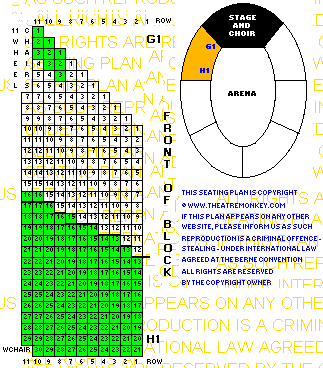
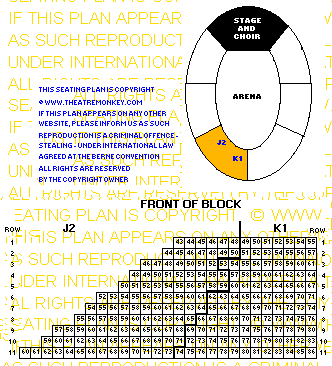
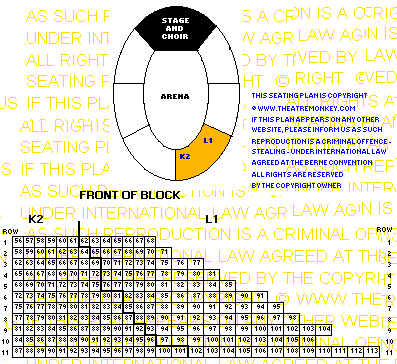
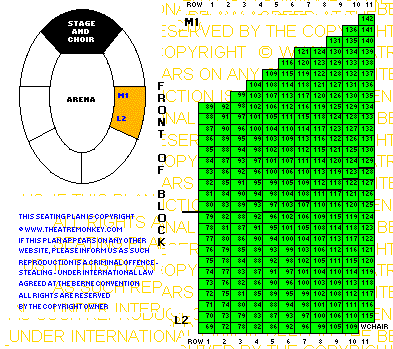
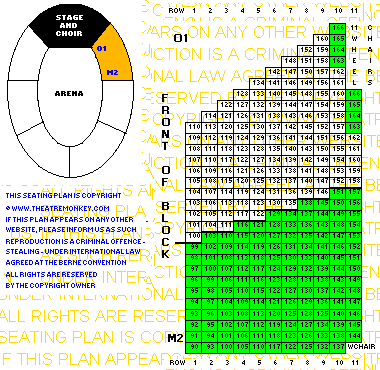
Blocks H2 and M1 are prime, then H1, M2, O1 and G1. Next come L2 and J1 then K1 and 2. L, J and K are towards the rear of the arena, further from the stage. Sound can suffer for orchestral concerts in these blocks.
The stage often juts out in front of the first six seats in block G1 / last six in block O1, placing you level with the performers. The rear corners of O1 and G1 are often sold as restricted view and are a bargain
In block J1 the best seats are: row 1 seats 32 to 42, row 2 33 - 43, 3: 36 - 45, 4: 37 - 47, 5: 38 - 49, 6 and 7: 40 - 51, 8: 42 - 54, 9: 43 - 56, 10: 45 - 58 and 11: 45 to 58.
In block L2 the best seats are: row 1 seats 79 - 69, 2: 82 - 72, 3:88 - 78, 4: 93 - 82, 5: 96 - 86, 6: 103 - 92, 7: 107 - 96, 8: 111 - 99, 9: 117 - 105, 10: 122 - 109, 11: 115 - 28.
Wheelchair space is available in blocks G, H, J, L, M and O. Users should choose this last after a box.
General hazard notes
Corner seats nearest the stage have a restricted view.
Rows 1 and 2 may not see over heads if arena users are standing.
Sound is variable in the blocks facing the stage. A reader feels, "The sound system was completely upgraded in 2019 and now sounds great almost everywhere. The only issues I've heard since are in the choir level where on-stage speech can sometimes be a bit echoey and harder to understand than other areas, but otherwise few sound complaints these days other than from specific shows." The monkey is yet to be convinced.
Row and aisle ends have metal posts / rails. These don’t affect sightlines, but may upset purists.
Changes for the current production
None.
Readers comments
"Stalls. The stalls boast some of the best seats in the whole building in my opinion. Anywhere in K stalls at all practically guarantees the best seat for quality of sound and comfort. However, many of the seats are hard to come by for most of the year as most of the section is predominately owned by members (of which for about 80 percent of the concerts, they get priority on). The rest of the stalls are fine. For a slightly different experience, I would recommend near the front of G or O stalls as you will incredibly close to the performers."
"Stalls. (James). Have sat in various seats in Stalls blocks J2, K1, K2 and L1 for the Proms – great sound and a good view from every seat I’ve had. Although for the I would recommend sitting from row 3 backwards if you want a clear view of the stage as your view can be obscured by the heads of those standing in the Arena! (The monkey notes that the arena is used for standing space for the annual "Proms" season and a few pop concerts each year).
"Block G, row 5, seats 5 and 6: (Bob Pickett). These are unusual seats in that they’re to the side of the stage, but to ensure a decent view they swivel! This neat trick means you can line up with the action (and track it to a degree as it moves). OK, anything plumb front of stage is going to point away from you, but you’re really close to the stage and get to see everything that is happening. Comfort and legroom both OK, sightlines good as the rake is quite generous at this level. Well worth considering, especially for large ensemble shows (like The Car Man)."
"Block H , Row 10 seat 30: This was a great seat to see the conductor and the orchestra and somewhere I would recommend for concerts.
L2, Row 11 seats 120 – 123: "Kooza" (January 2013). A great view of the stage, legroom OK. Being on the back row we were well raised up – perfect for this show. Sadly with the current stage set up there were cables and pulleys in our direct eyeline but you could see through them, and all my party said at the interval that they stopped noticing them very quickly. I particularly liked the fact that the row behind were the boxes, meaning that they were well raised above us, therefore no hassle from people complaining about their sight line!!! They were priced in the second price bracket – I think this is fair as it was a side on view for a couple of acts, but still well worth the money." (Note that "Kooza" used about half the arena space, so has a very different layout to the usual - editor).
"Block M, row 6, seats 109 and 110: "2019 Proms." Great location for the proms, close to the stage but not a side on view. Clear view of the full stage and the choir. The seats themselves have plenty of legroom, even for over 6ft and as they move from side to side it also means they have plenty of room width ways. The seats further round, at the centre of the stalls, are slightly higher priced but are slightly further from the stage and other reviews say the sound may not be as good there. It is a much smaller venue than looks on the TV, apart from height wise, so you can't go much wrong in the stalls really. This kind of location was a pretty spot on area to watch the proms from however. It is worth having a trip up in the lift in the interval to gallery to appreciate how high it is up there."
"Block M, row 6, seat 112: "Space Spectacular" (May 2016) The show wasn’t completely sold out, so I received a free upgrade to Stalls M, Row 6, Seat 112. It’s a bit of a sideways view, but you can swivel the chair. Unlike the Arena, the Stalls are raked, the seats comfy, the view is great."
"Block M, row 6, 117-118: On the right of the stage and giving a clear view. Plenty of legroom, good rake and on the aisle for a quick getaway. The angle is a little sharp so ideally I think a couple of blocks further round away from the stage would be preferable, but absolutely no complaints about these whatsoever."
"Block M2, 92 and 93: “Opera In The Round" production (Carmen in March 2009), (Cristopher H). The view was great! We had one eye on the amazing bullfight and other in the arena where Carmen was being killed; I recommend these seats to anyone. The Royal Albert was not in its full splendour, as the organ was hidden; but as always it's awe striking to see the auditorium itself. Drinks are very expensive and the toilets aren't very accessible but this was overshadowed by the performance."
"Block O, Row 1: This was an OK seat, it was great being close to the front... but you are behind the performer (as I was for the show I saw - Katherine Jenkins in December 2009) so I'm not sure I'd like to sit there again; and for people paying full price I would advise them to sit one block further round."
Boxes
Layout
Three tiers of boxes encircle the arena above and behind the stalls. Most are privately owned (originally sold to raise money to build the venue) and not open to the public unless the owner allows the box office to sell on their behalf.
The lowest level is the “Loggia Level.” Above this is the “Grand Tier” level. Above that are the “Second Tier” level boxes.
At the Loggia level, doorways and aisles between boxes 6 and 7, 12 and 13, 18 and 19, 24 and 25 and 31 and 32 lead down into the stalls area; which is directly in front of all Loggia level boxes.
As a general rule (there are exceptions to prove it!) the lowest level Loggia Level boxes seat eight, middle level Grand Tier twelve, and highest level Second Tier five or eight.
When sold, seat numbers apply to allow a single ticket to be sold. In a five person box, 1 and 2 are at the front, 3 and 4 behind, and 5 is a tall chair behind that.
In an eight person box 1 to 4 are front, 6 to 8 behind.
In Grand Tier boxes 7, 9, 81 and 83, the rear 4 seats are arranged in pairs on high plinths with a rail in front.
In a twelve seat box, as reader Rex Holder noticed, 1 to 4 are front, 5 to 8 are behind, with 9 to 12 in the rear.
Boxes 1 and 2 (2 and 3 on Grand Tier Level) can be combined to form a larger space if needed.
Legroom
Front rows have variable legroom - improved at Grand Tier level, less at Second Tier level.
As a rule, boxes to the sides of the arena have more than the ones facing the stage, due to the curve of the front wall.
For example, Grand Tier Box 40 the monkey noted seats 1 to 4 in the front row were suitable up to around 5ft 7. Second row 5 to 8 up to 5ft 11 or so, third row had unlimited legroom as chairs can be moved to suit.
In Grand Tier boxes 7, 9, 81 and 83, the rear 4 seats are arranged in pairs on high plinths with a rail in front. The legroom is very comfortable for those up to at least 5ft 10 or so.
Seat 5 in the smallest boxes is a tall chair, with maximum legroom – but will leave shorter persons hanging a little...
Choosing seats in general
Loggia level boxes 1 to 4 and 31 to 35 are closest to the stage.
Loggia level boxes 5 and 35 accommodate wheelchairs and command a fine view. Users should take these over block K.
The box office notes that in the 8 person boxes closest to the stage ( Loggia Level 1,2,3,4,5,6,31,32,33,34,35,36; Grand Tier level 2,3,4,5,6,7,36,37,38,39,40,41,42; 2nd Tier level 7,8,9,10,81,82,83,84) the viewing angle means that the seats closest to the stage i.e. 1, 2, 5 and 6 actually have an awkward viewing angle of the stage. The other seats offer a slightly better one!
In the grand tier 1 to 10 and 35 to 42 are closest; boxes 1 and 42 can have metalwork in the way, obstructing the view from the corner of the box. Boxes 2 and 3 can be combined to form a larger space if needed. The monkey noted in box 40 that the back row lost about 10% of the near stage - seems more, but in fact the stage doesn't begin until further along than you may think. The middle row lost a bit more as it isn't as elevated. The front row lost least.
In the second tier it is 7 to 24 and 84 to 67, with 7 and 84 prone to suffering metal rail problems. Boxes 81 and 82 and also boxes 83 and 84 are combined to form a larger space if needed. The monkey lost only a little of the near stage from box 81 seat 8. The rail in front was not an issue. A head leaning forward can be - polite word is enough.
Other boxes offer good but slightly distant views. The sound is good in all and Theatremonkey likes these as a slightly more expensive, but comfortable, alternative to the balcony. Put another way, a box at the RAH is an experience not to be missed, just be aware that a larger person in front will impact on sightlines.
General hazard notes
Boxes 1 and 35 can have metalwork in the way, obstructing the view from the corner of the box.
All boxes that don't face directly down the hall have side views, and within each box, some seats are better than others.
Changes for the current production
None.
Readers comments
"Put simply, unless you are booking as a full group of 8 for a loggia box, DO NOT book the back row. Your sightline will be obscured by any number of things, from the people in the front row, people in the stalls seats in front of you, and the pillars that adorn certain boxes around the hall. For the same price, and for sometimes even less, the stalls and arena seats can bought for a better view and experience.
In the grand tier, it doesn't matter as much since the seats are on raised steps as they go up. However, for events in the round, avoid anything other than the front row as the people in front will definitely lean forward at certain sections and block your vision.
In the second tier, the same rule applies to the loggias, don't book for anything other than the front row unless you're booking out the whole box. AVOID SEAT 5 AT ALL COSTS! Seat 5 is incredibly awkward to manoeuvre in every box and you certainly won't get a decent view of the stage, no matter where the box is placed. There are boxes at the sides which have 8 seats per box and these ones have a good view on either row. If you want to book a second tier box as a couple or three, book one of these to avoid disappointment.
One more note on the boxes, at almost every event at the hall there will be corporate parties in the boxes, it's how the building makes it's money. These people can invariably be obnoxious, uninterested and loud. If you want to enjoy your concert and have a nice experience as well, I would highly suggest avoiding the boxes as you can find yourself in amongst less like-minded people who won't take kindly to being told off by you or a member of staff. The stewards won't be able to provide much jurisdiction either as these corporate boxes will be providing a lot of cash for the venue and the 'powers that be' will claim there hands are tied. Proceed with caution!"
"Loggia Box 25, seat 4: "Whose Line Is It Anyway?" (December 2018). The boxes have free standing seats so it is possible to move them around slightly to improve sightlines or leg room, but not much. They’re also high up enough from the row in front (in the stalls), so that in the front row of the box, you shouldn’t have your view obscured by folk in front. Seat 4 is on the right hand side of the box on the front row and is very limited on leg room. Seats 5-8 on the second row have better legroom but potential to have your view blocked by someone tall in the front row of the box, as the second row is slightly, but not much higher than the front row.
I found that with the position of this box (to the right of the stage) seat 4 (and 5 behind it) had a partly obstructed view of the far right of the stage by a pillar. For the performance I attended, there were large screens showing the main action on stage, but the position of the pillar meant that the musicians on the far right of the stage weren’t visible except by a lot of head waggling. I also found I was the ‘odd one out’ in a group of 7 others who’d booked tickets together, but they were quite friendly and apologised in advance if they were going to be ‘boisterous’. Luckily the comedy nature of the performance meant this wasn’t a problem, but I might think twice about a single seat in a box for a non-comedy performance."
"Grand Tier: Box 35, Seats 3 and 4: "Cirque du Soleil." These are two of the four front seats in this box. They are good for any 'In The Round' events and were perfect for the Cirque du Soleil show we were watching. Height is important for that show as much of it is performed above floor level. We had a superb view of everything."
"We were in a box on the 2nd floor. A very good seat in fact. But the people in the box next to us were....well, how can I put it politely? They seemed to be there mainly to eat and talk and get drunk. My wife was astonished that during quite an emotive piece (Faure) one of the women suddenly leapt up and started passing sandwiches round! Without wanting to be offensive, I would have described them as people with money but no taste - typically boorish hooray-henries (do people still use that term?). I would certainly think twice about getting tickets for a box again if this experience is common. Perhaps we were just unlucky..."
" (Marcus Watney, Oxford). To add balance to the comment about the 'Hooray-Henries' in one of the boxes passing around sandwiches at the RAH ... I had the opposite experience. I bought a single front-seat ticket in a box, and found that the slightly select nature of being in a box encouraged conviviality: we all shook hands and introduced ourselves, and before the concert started we talked about previous occasions we had heard the artiste, anecdotes, etc. Everyone was very considerate, shifting chairs to give those behind a better view, etc. It proved to be a very relaxed and pleasant way to enjoy a favourite performer."
“(Larger reader): We were in box number 25 with an amazing view. All the boxes appear to have the same chairs however... These are free standing metal chairs. As a larger person I often find seats in the theatre "snug" but this was the first time that I have ever found a theatre seat that I absolutely could not fit in. This was mortifyingly embarrassing... the seats were very narrow.. even my husband who is tall but not fat, found them to be extremely snug. I decided to ask our box host (member of staff) whether there was a chair without arms - he was not sure but very quickly came back with a chair without arms. As the chairs were free standing it was possible to swap the chair and I was able to enjoy the show in comfort. I wanted to let you know that these seats may not be suitable for larger people."
"Box 60, seat 1": Wonderful seats, unobstructed view for 15th December 2016 performance of Handel's Messiah. The only issue was with noise - could not go 15 seconds through ENTIRE performance without someone coughing/sneezing/fidgeting/whispering. The acoustics are excellent, but that cuts both ways. You could hear the person across the theatre coughing - really sad."
Box 77 seat 5: "I have to disagree with what has been said about the 2nd Tier boxes at the Royal Albert Hall. I was in Box 77, Seat 5, and found out that it was actually a tiny 5-person box with 2 seats in front (the only two with unobstructed views), two seats behind them on a step, and Seat 5, which was actually a chair on a platform that was placed behind the line of the box's curtain and which had a view of only 1/3 of the stage when I was seated. The best I could do was stand up for the first half of the concert so I could see about 1/2 of the stage, before I went out to complain at the interval and was moved to a lower seat where I could actually see the entire stage.
I found myself in a group of people complaining to a member of staff that we'd paid top price for tickets a concert, only to end up with highly obstructed-view tickets, and eventually they did admit that the small boxes are mostly owned and populated by family groups who squash together at the front of the box so they can see. Not possible when you have five strangers in a box and the only unobstructed view is from the front row of two seats.
Please note on your site that people need to be careful what seat they have in the 2nd Tier, and I suggest they use the RAH site to buy tickets as you can see which seat is where, unlike buying them blind through See, which stated I was in "Row 1". Anything other than Seats 1 and 2 in the tiny 5-person boxes is a highly obstructed view unless the people in the front row will let you sit on their laps."
"Box 82: For an experiment I test-sat here. About 3 o'clock with the stage at midday. The two seats in front are ok, the two seats behind need some leaning forward or about half the stage is lost and behind them there's a single high chair. You'd see more on the radio than you would sat here, so be very careful choosing those. I didn't really check to see how it would be for something using the floor of the Arena but I can't see it being any better."
"Loggia Box 12: we had seats 1 and 2 in loggia box 12 at a concert in 2010. My sister sat in seat 2 and had a great view, but I sat in seat 1, which had a supporting post right in front of me, so my whole view of the stage was obstructed, I had to lean either to the right or left to see, which resulted in an aching back and neck! I complained during the interval and was re-seated, however, I feel that when I booked my tickets I should have been advised of the obstructed view and that the ticket price for that seat should have been reduced in price to reflect that obstruction - I paid full price £75! (The monkey has sat in seat 5 in other boxes and not had a problem, so it would very much welcome other comments on this).”
"Second Tier Box 18, Seats 1 and 2: These are the two front seats in this 5 seat box. We watched a concert on the stage from here. The view is unobstructed, though you will be looking to your left throughout the performance. Fortunately the seats can be moved to make viewing more comfortable. These would be excellent seats for viewing 'In The Round' events. I agree with a reader comment made previously on this site - AVOID SEAT 5 AT ALL COSTS! The view from seat 5 in box 18 is dreadful."
Circle
Layout
Seven rows of seats above and behind the boxes, high above the arena.
Aisles split the seats into blocks, and separate parts of the front row from rows behind in some sections.
Legroom
Cramped in almost all seats - row A has nothing for those over 5ft 4 or so. Any with legroom will have rails in front and thus a restricted view.
A reader cautions:
"Leg room was appalling. None of the five of us were very tall but we were very uncomfortably squashed. At 5’3” I was just able to sit square - taller members our party had to sit sideways. Luckily we had an aisle seat for my eldest son who is 5’ 10” ( ie not exceptionally tall) but he found it almost impossible to sit in the other seats."
The monkey felt 5ft 6 would be pushing the limits, too.
The best relief is in the few seats with aisles in front of them. These are Row 7 numbers 8, 9, 37, 38, 67, 68, 96, 97, 126, 127, 156, 187, 215, 216, 245, 246, 274 and 275.
Also worth a look are seats on row 4 which have a handrail in front, as they have space for one leg where there is flat area under the rail instead of a seat. Block P row 4 seat 7 and block Y row 4 seat 223 are examples.
A few seats have stairwells in front and allow a little extra space. These are Row 3 seats 8 to 12, 13 to 17, 46 to 52, 53 to 59, 88 to 93, 94 to 99, 128 to 134, 170 to 174, 175 to 179.
All aisle seats provide some stretching space for one leg!
Choosing seats in general
All seats are subject to thin metal bars in front of them, and down aisles. These do not interfere with the view very much, but if such things really bother you, try row A - though there is still a low bar here - or choose the Stalls or boxes instead. The monkey mentions this though, just so readers know!
Best views are from blocks Q1 and X2, then P2 and Y1, or you could try restricted view seats behind the stage in P1 and Y2, which can be a bargain. With full view, though, next choice for the monkey are blocks Q2 and X1.
Blocks W2 and R1 are over halfway around the arena and are next choice before blocks S, T, V, and lastly U at the farthest end of the hall from the stage.
The sound is surprisingly good in the side blocks nearest the stage, but grows progressively quieter towards the back of the arena, and there have been complaints about the sound during arena based productions in the past.
General hazard notes
Rails and bars in front of and / or beside each block and row affect views from almost all seats.
Sightlines vary depending on stage layout and height for all productions.
Sound issues are common for those in the rear of the arena. A reader feels, ""The sound system was completely upgraded in 2019 and now sounds great almost everywhere. The only issues I've heard since are in the choir level where on-stage speech can sometimes be a bit echoey and harder to understand than other areas, but otherwise few sound complaints these days other than from specific shows." The monkey is not convinced.
The circle can get hot or cold on a block-by-block basis. No reason, just that it has its own micro-climate, the monkey thinks.
Changes for the current production
None.
Readers comments
"Circle: Sat here twice. One night to the right of the stage second time in the middle at the back. Absolutely appalling! I suppose that you go for the music but I found both times to be so extremely uncomfortable that I would rather have not gone at all."
"Circle: "Space Spectacular" (May 2016). You want facial expressions? Dish out the big money for arena seats. I prefer lower prices. From most of the circle you have a great view of not only the stage but also the beautiful auditorium. Legroom is an issue. I’d go for the end of an aisle or even the seats on the top of the stairs, last row. Doesn’t make much difference in terms of sight and sound, but you can stretch your legs. A warning: Due to the lack of a proper air-con it can get warm and cozy up there, especially during the summer months, and I have more than once dozed off during a not quite thrilling classical concert."
"Row C: I would like to add a comment re the Albert Hall Circle. We have sat in this once or twice and found it OK but on our last visit we were allocated 5 seats in row C – can’t remember the numbers but they were close to an entrance with a walkway in front. The seats were raised above the walkway so vision was fine but there was of course a barrier in front. Leg room was appalling. None of the five of us were very tall but we were very uncomfortably squashed. At 5’3” I was just able to sit square - taller members our party had to sit sideways. Luckily we had an aisle seat for my eldest son who is 5’ 10” ( ie not exceptionally tall) but he found it almost impossible to sit in the other seats. Definitely to be avoided."
"Block P, row 3, seats 11 and 12: (Paul). First the pluses... These seats are above a stairwell therefore nobody immediately in front. Also the acoustics from that position were fantastic. On the other hand... the seats were sold to us as 'restricted view,' however it was 'severely restricted' for this show ("George Michael In Concert, October 2011). We could see the far half of the stage, and the bottom quarter of the backdrop. Half the orchestra were visible. Thankfully George spent 80% of the time sat or stood and the front centre which meant we could see him so long as the people on row 1 didn't lean forward too much!
Legroom - non existent. I was wedged in and not going anywhere. A wall between the seats and the stairwell with a metal bar under the lip meant that I could barely move! Much has been written about how slow paced this current GM show is - it's a good job, as these seats were designed for sitting and listening, not getting up and dancing!
Overall, these seats would be fine (although still restricted) if the event you are going to is in the central arena or you are happy not seeing what is on the main stage - if priced accordingly they would be OK. But for anything with a spectacle on the end stage, avoid unless you have no choice, and then only if you are desperate to go. In the scramble for tickets this was all we could get. A great place to watch the audience though!"
“Block P: "Cirque du Soleil" production "Alegria" (January 2005), the production was staged in the central arena. (Roberto Trotta). "We had seats in the P-section of the Circle, marked "restricted view" and sold at £22.50. I would like to point out that the view is really bad, for two main reasons: the first is a bulky metallic structure mounted over the back of the stage, which hinders the view to the performance. The second is that some parts of the show are carried out in front of a curtain which actually is seen from behind when one is seated in the "restricted view" places. As a consequence, large chunks of the show are completely invisible.
Also, pretty much the same situation applies even to the fully priced seats in sections Q and R (and similarly to the corresponding sections on the other side of the hall, X and W), and would strongly advice NOT to buy any tickets in those sections, since the view is severely impaired and for this show they are really bad value for money. The same is true even for more highly priced seats in the boxes below. Quite apart from those considerations, the show is highly entertaining and enjoyable. I suspect that the standing places sold at £16 are not a good bargain, either. Although they are fully in front of the stage, I reckon that another metallic structure supporting some lights might be just on the line of sight, effectively cutting the view to a large chunk of the stage and to some of the most spectacular parts... (Haven't checked this for myself, though). (Note that his comments apply only to this particular production, staged in this particular way on this particular set. Readers may, though, find it helpful to ask for more details when purchasing tickets for similar "in the round" productions at another time – editor).
"P1, restricted view: (Jim). I noted this site's comments about Circle Block P1 restricted view seats. I thought they might still be OK for a concert, especially as it was difficult to buy any seat at all for REM (March 2008). However I had a problem no-one predicted. The height above the stage was ok, the angle was ok but somebody had suspended a lighting gantry directly in the line of view. I saw virtually nothing of Michael Stipes REM's singer when he stood at the front of the stage. Please add a comment about this to your site as it might prevent somebody else from having a frustrating evening. ( the monkey hopes other readers will note just how variable the situation in block P can be).”
“Block Q: "Attended the 'Echo & the Bunnymen' concert last night (16th September 2008) and was disappointed to find that our view was obscured by some safety railings. This certainly wasn't made clear on the RAH website at the time of booking. Our seats were: Circle, Block Q, Row 4, Seats 30/31. Apart from that, the view was a bit "steep" and somewhat distant but the railings were the main issue. Happy to send an explanatory photo, if you wish. Still thoroughly enjoyed the concert but think that the RAH could be a bit more up-front about these issues. Leg room pretty good for a 6'4" bloke, by the way."
“Block R: We went to the Albert Hall on Saturday evening July 3rd 2010 to see the Crosby, Stills and Nash concert. They were ok, not helped by the poor acoustics. Our seats were in the top layer door R, Row 7 (back row), leg room was better than other seats we’ve had at that level.
Everything else was the usual Albert Hall low standard, huge queues for the totally inadequate toilet facilities, out of order lifts and worst of all; the temperature. It was far, far too hot in the auditorium, the air cooling system is useless, quite a few people left at the interval and we had to leave early as my wife was starting to feel faint."
"Circle T and U: My favourite seats in the entire venue are in the front row of Circle T and Circle U. These are a steal for 'Cirque Du Soleil' events as the whole extravaganza will be visible from these seats, and not so much from down below.
It does get very hot up there, the hall can't build a traditional air conditioning system there on account of it being an 'English Heritage' venue. In all honesty, they would have to close the building for a period of time to put one in. So don't expect one to appear any time soon, bring a fan.
The only other thing I'll mention about the circle is if your ticket says 'restricted view' it will be definitely be just that. If you can spare an extra 10 or 20 pounds I would advise upgrading the middle of the circle or even to drop down in price and get a gallery standing ticket, if you can hack it."
"Block T, Row 5 Seat 107 and 108. First time in the Rausing Circle for a while and it wasn't as bad as I'd anticipated. You get a great view of the whole arena and because these seats are on an aisle they don't seem as claustrophobic as I feel you might further down the row. Uninterrupted view as the rake is steep. I'd sit here again, which is surprising as I was fearing the worst having read your reviews!"
“Block V, Row 3, Seat 134: “The Who/Squeeze” (2024). They say that it's ‘Limited Legroom’ and they are right, I'm 5'8" and I had very little room to move. The view is OK, very high obviously, and if you are at a pop/rock thing you might get a bit disturbed by people coming and going to the bar as they pass underneath you. But no physical blocks of the view, though you do sort of feel you are watching an event at a distance rather than being part of something.
This is with the stage in the conventional place. For events that cover the arena, about a third would be out of view. The sound was really good, and some reviews have mentioned that... so perhaps they have a better front of house sound person - but no complaints there.”
"W1, row 1, seats 162, 163: "Christmas carol singalong" (December 2012). Perfect view of the stage, legroom very tight. The sound was crystal clear – would happily go for these seats again if the price was right. I think finding any seat in the circle with adequate legroom is virtually impossible but it was so much better than the seats in block P we had last time! On an aside though, I felt sorry for the stewards in this area. How hard is it to understand why you shouldn't put your coats and bags on the barrier overhanging the main auditorium? He must have leant over to the people near us at least 6 times during the performance."
“Block W, Row 6 seats 188 and 189: “Aida,” (Chris B). This is such a huge, magnificent building that is almost worth getting seats this high up just to fully appreciate the splendour of the place. As for the show, you are obviously far too far up to make out any details of the actors etc, but as we saw an opera, it’s such an honour to sit and listen to the wonderful music. The stage is enormous and took up pretty much the whole of the stalls area. The seats themselves are comfortable, with ample legroom, but if you want to see the show in any detail I’d suggest much lower down. However at a discounted price, these seats allow you to feel part of the show and soak up the atmosphere.”
Promenade
Layout
Also occasionally known as the balcony. A gallery that encircles the hall high above and behind the balcony.
Legroom
Standing area, so not a case of legroom more a test of leg strength...
Choosing seats in general
Mostly sold during the promenade concert season, the atmosphere her is terrific, the sound average and the view vertigo inducing.
Arrive early to nab a bit of balustrade to lean on / wall to lean against.
The monkey liked the bit near the stage even though it has a restricted view, so maybe a little further round is even better.
A unique RAH experience to try just once.
General hazard notes
Vertigo.
Leg fatigue.
A long climb to this level using the stairs.
Changes for the current production
None.
Readers comments
None.
Notes best seat advice
Seats 5222 maximum depending on production
Air conditioned. A reader notes that, "A major air cooling upgrade was installed during the Covid closure in 2021 which has made the temperature in the building much more pleasant, particularly in the Circle levels. In July 2022 the hottest day in UK history was recorded and to everyone's relief the air cooling worked and the building was much nicer than what it would have been just a few years earlier!"
Hearing loop available with headsets obtainable from a desk at door 6. Occasional signed performances. Lifts and ramps allow access to all levels, entry at doors 2 and 8. Wheelchair users get boxes and space in stalls blocks - 28 of them. Guide dogs are either allowed to remain with owners if the owner is seated in a box. Otherwise they can be dogsat by staff. Two unisex adapted toilets available. Allocated parking spaces. A good effort. Call the hall on 020 7070 4410 for full details Monday to Friday 10 am to 5 pm. Note that this number is for access information only and is NOT for general use.
Restaurant in building, call 020 7589 8900 for reservations in the Elgar Room restaurant. Box owners can call 020 7589 5666 to arrange catering in their box on the night. Confectionery and ice cream in auditorium. You are not supposed to picnic in the boxes unless you pay for in-house catering. Disguise your goodies in long wigs and dark glasses before entering. Or take out a mortgage to pay hall food prices.
Toilets have been added to the Hall since it opened without any - Victorians thought them too rude to include at first. Insufficient number at all levels for ladies according to theatremonkey reports. Just adequate for gentlemen. In July 2010 a visitor noted,
"Everything was the usual Albert Hall low standard, huge queues for the totally inadequate toilet facilities."
Monkey advise is to go to the "Grand Tier" or "Second Tier" box levels as there are fewer seats and shorter lines.
General price band information
Theatres use "dynamic pricing." Seat prices change according to demand for a particular performance. Prices below were compiled as booking originally opened. Current prices are advised at time of enquiry.
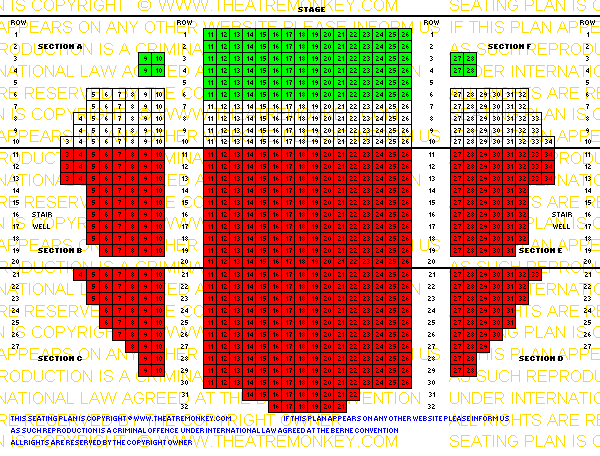
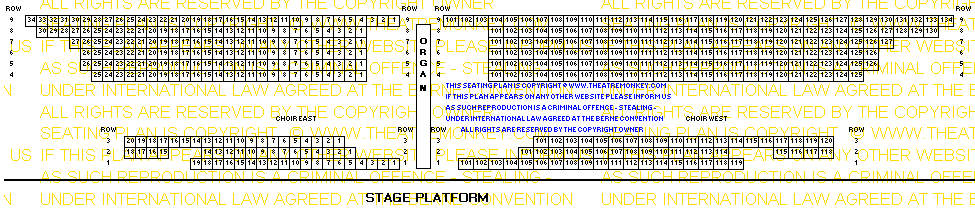
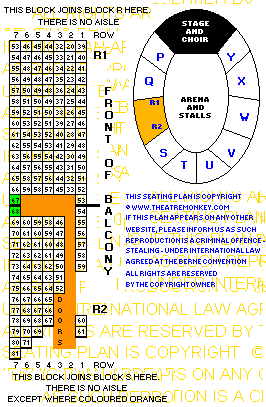
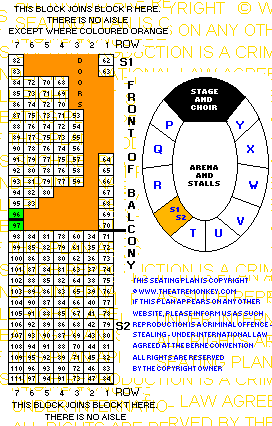
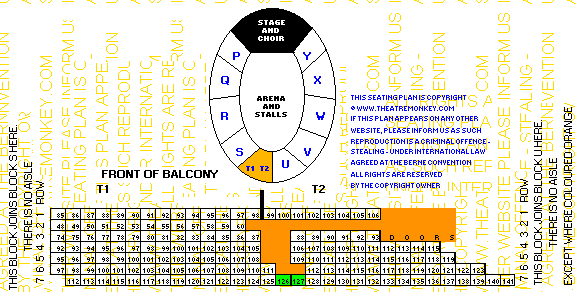
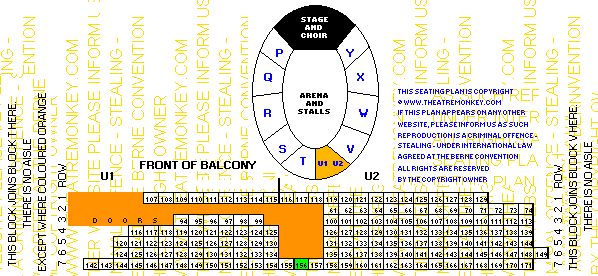
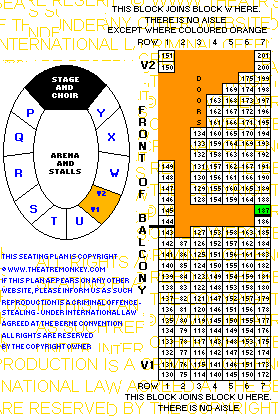
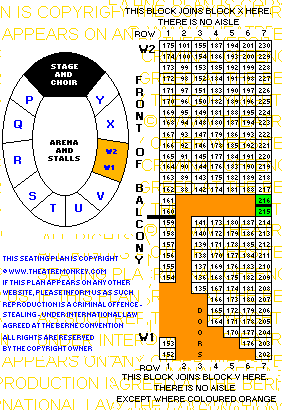
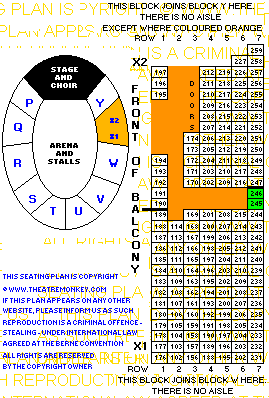
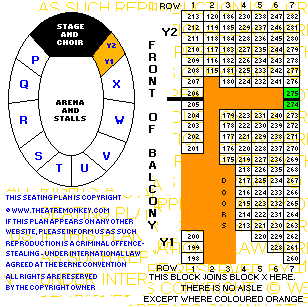
Based on paying FULL PRICE (no discount!) for tickets, site writers and contributing guests have ALSO created the colour-coded plans for "value for money," considering factors like views, comfort and value-for-money compared with other same-priced seats available.
For a full discussion, opinions, reviews, notes, tips, hints and advice on all the seats in this theatre, click on "BEST SEAT ADVICE" (on the left of your screen).
On the plans below:
Seats in GREEN many feel may offer either noticeable value, or something to compensate for a problem; for example, being a well-priced restricted view ticket. Any seats coloured LIGHT GREEN are sold at "premium" prices because the show producer thinks they are the best. The monkey says "you are only getting what you pay for" but uses this colour to highlight the ones it feels best at the price, and help everybody else find equally good seats nearby at lower prices.
Seats in WHITE, many feel, provided about what they pay for. Generally unremarkable.
Seats in RED are coloured to draw attention. Not necessarily to be avoided - maybe nothing specific is wrong with them, other than opinions that there are better seats at the same price. Other times there may be something to consider before buying – perhaps overpricing, obstructed views, less comfort etc.
Please remember that cheaper seats often do not offer the same view / location quality as top price ones, and that ticket prices are designed to reflect this difference.
CLICK PLAN TO ENLARGE IF REQUIRED. CLICK "BACK" BUTTON TO RETURN.
By value for money:
Arena
Choir
Stalls
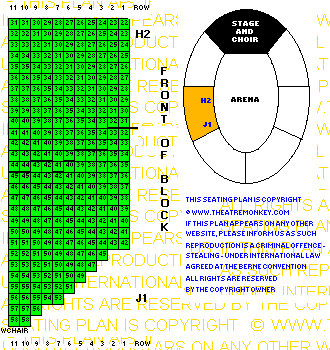
Boxes
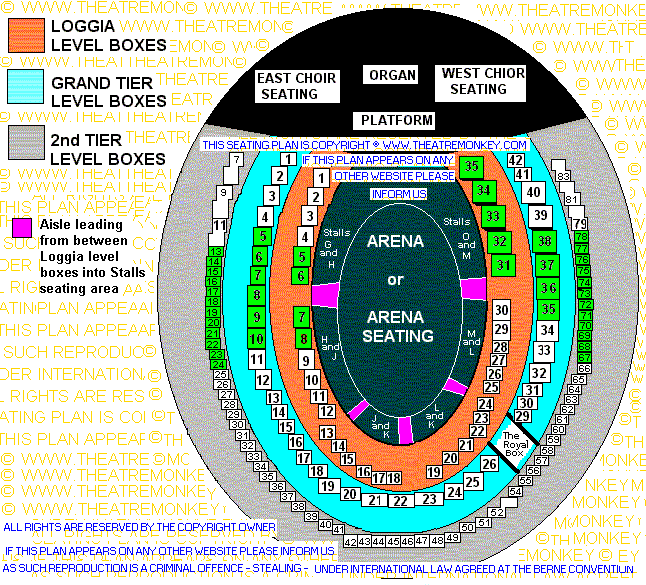
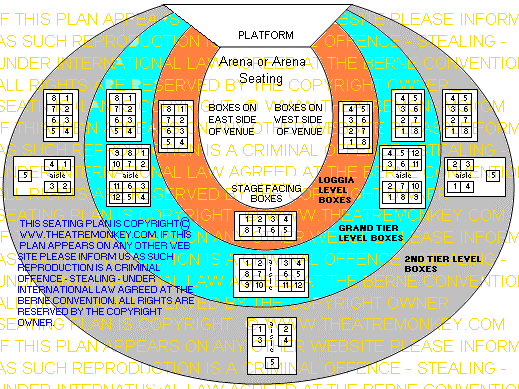
Circle
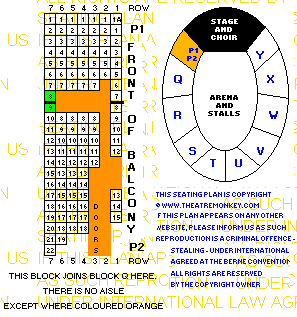
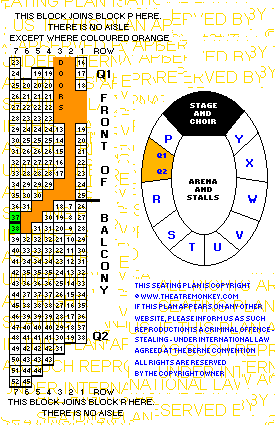
Notes
Please note: The seating plans are not accurate representations of the auditorium. While we try to ensure they are as close to the actual theatre plan as possible we cannot guarantee they are a true representation. Customers with specific requirements are advised to discuss these with the theatre prior to booking to avoid any confusion.
-0.1795547, 51.5009121
Nearest underground station
South Kensington - Piccadilly Lane (dark blue), Circle Line (yellow), District Line (green).
On leaving the barriers from South Kensington tube station, turn immediately to your right (i.e. while still in the ticket hall), following signs for the subway to the museums. (If you are in a shopping arcade at pavement level, then go back down the stairs to the ticket hall and look for the subway instead.)
Walk along the entire length of the subway, ignoring exits for the various museums. A reader notes that the subway is closed from about 10 pm, so it might not be open after an evening performance.
At the end of the subway, take the stairs to street level. You should be next to a post office, with a large church facing you on the other side of the road (Exhibition Road). As you come out onto the pavement, turn left. You should be walking slightly uphill, with the church (large golden spire) on your right.
After walking for a few minutes, you will reach a small roundabout for Prince Consort Road (which runs to the left). Cross Prince Consort Road and turn left into it.
Take the first right turn (Albert Court) and follow this curved road until you reach the Albert Hall.
Theatremonkey is very grateful to the reader who researched and provided this excellent walking route to the venue.
Buses
9, 10 and 52 run past the door.
A reader also adds, "360 (a single decker) goes from the back of the Hall. It starts at the Hall and the route is Exhibition Road, South Kensington (tube), Sloane Avenue, Draycott Place, Sloane Square (tube), Chelsea Bridge Road, Lupus Street, Pimlico (tube), Vauxhall bus station/tube, Albert Embankment, Black Prince Road, Kennington Road and Elephant & Castle (tube), where it terminates. In case you're wondering about the detail, this is the bus I take! The bus stop can found by going down the stairs at the back of the Hall (into Prince Consort Road) and turning immediately right."
Very helpful, thinks the monkey.
Taxi
Pre Book, or hail one in the street outside.
Car park
This is rented in the evenings from nearby Imperial College. Book your space in advance from the box office and cruise in while others take their chances. This is very worthwhile as on street parking is severely restricted.
From the car park turn right, change to the other side of the road and walk along to the wide stairs on your right. Go up these into the plaza housing the Royal Albert Hall.


Legal
Social Media
© 2000-2025 "Theatremonkey," "Theatermonkey," "Chip" and "Sammy" are registered trademarks. Buy your tickets with confidence here. Theatremonkey is an Affiliate Member of STAR. All rights reserved.
Readers comments
"Choir: I have nothing further to add to what is already on the page, except that if booking for an event in the round, book for the far end of the rows. Even higher up you'll find a better view and sound, since you won't be quite so close to the orchestra which will invariably be on the stage.
The sound system was completely upgraded in 2019 and now sounds great almost everywhere. The only issues I've heard since are in the choir level where on-stage speech can sometimes be a bit echoey and harder to understand than other areas, but otherwise few sound complaints these days other than from specific shows."
"Choir: Choir seats as the best ever place to watch classical music. Until a couple of years ago, all Choir seats at the Proms were the same price as standing. Someone has realised that they are great seats and now there is a charge of 'normal' prices, though some remain available at Prom prices. You are pretty much above the orchestra, can watch the conductor's eyes, and the sound is great.”
"Choir Row 1, 108 and 109: (August 2014). "During the BBC Proms season, at the back of the stage there is an LED screen running the whole width of the platform in front of the choir seats. For the first time since they started doing this, I was allocated row 1 seats in the Choir (seats 108,109). Since the structure that holds the LED screen projects about a foot in front of the parapet and level with its top, it obstructs the view of the upper levels of the stage. For Mahler's 4th Symphony, I could only see the strings at the front of the platform, plus the percussion to my right. All the brass and woodwind were invisible. My wife, who is slightly shorter than me, had an even worse view. I understand from one of the stewards that the LED screen is there only for the Proms. So I suggest you should make a note that during the Proms season, row 1 of the Choir is RESTRICTED VIEW (though with no reduction in price)."
"Choir East, Row 3, 9 and 10 (Bob Pickett): What unusual seats! Bear in mind these ARE for a Choir, so behind the performers. Sound (as you’d hope) is spot on, they’re comfortable enough with just about adequate legroom. It does (as we did when seeing Bryan Adams) allow you a great, if different view of the band, but they are going to be facing away from you most of the time. You do get to see a bit of backstage activity, so if you’re interested these are for you.
At the right price, and if it’s a show where you don’t really need to be in front (an orchestra springs to mind) then they’re worth considering."
"Choir West, Row 9, seat 120: (Proms, August 2024). This is the back row of the choir, which is separated from the rows in front, and has a padded ledge in front of you. This prevents you seeing maybe 10% of the stage - in our case the brass section of the audience.Leaning forward a little sorts this out.
For £8 I don't know a bigger bargain anywhere, though as you are at the back any instruments doing quiet solos may be lost a little."