
Lyttelton Theatre, the National Theatre
South Bank, Lambeth, London SE1 9PX 020 3989 5455
- Where to buy tickets
- Best seat advice
- Seating plan/s
- Getting to the theatre
Buying tickets online
www.nationaltheatre.org.uk the venue's own website provide the service.
This venue allows individual seat selection for most productions. You can also view the auditorium via photographs taken from various positions within it.
About the show:
Inter Alia
Hamlet
The Playboy of the Western World
Booking fees per transaction:
There is no fee for online bookings, cheaper than the £3 fee per booking, not per ticket, fee made for phone bookings.
Other Online Choices (with genuine S.T.A.R ticket agencies):
Independent S.T.A.R. ticket agencies may also offer an alternative choice of seats for some events.
Ticket agencies offer an alternative way to buy tickets, with booking fees differing from those charged by the theatre box office itself. They may have seats available or special offers when theatres do not.
Ticket agency prices vary in response to theatres implementing “dynamic pricing” - which alters prices according to demand for a particular performance. Current prices are advised at time of enquiry.
Box office information
Telephone: 020 3989 5455
Operated by Quay Tickets for the venue.
A £3 fee per booking, not per ticket, fee is charged for phone bookings.
For personal callers or by post:
Lyttelton Theatre, Royal National Theatre, South Bank, SE1 9PXX
No booking fee for personal callers.
A reader notes about "Day Seats" in person at the box office:
"I got to the box office about 9:30am and there was already a pretty longish queue outside (they don't let you move inside and start selling until 10, not great if it's raining). The queue took about 45 minutes so I'd suggest you take a book/ipod for the wait. The seats for the evening performance were all taken by then but there were still plenty of standing seats available. I was still able to get a seat for that day as there was a matinee performance with seats spare (Matinees are generally easier to get tickets for)."
Special Access Needs Customers:
Wheelchair users and other registered disabled theatregoers can book their seats and enquire about concessionary prices that may be available to them on 020 7452 3961 from 11am to 6pm, Monday to Saturday.
www.nationaltheatre.org.uk is the official theatre website.
Please remember that cheaper seats often do not offer the same view / location quality as top price ones, and that ticket prices are designed to reflect this difference.
- Stalls
- Dress Circle
- Dress Circle Slips
Stalls
Layout
The Dress Circle overhangs the stalls at row O making the top of the proscenium invisible from row T back if the whole height of the stage is used.
A single block of seats face the stage.
Rows A to D are on a flat floor. All other seats are tiered with steps between each row.
Legroom
Good in rows E to V for those up to around 5ft 10 or so and A for those up to around 6ft. It is just adequate in rows B to D for those over 5ft 5. The very end seat on each end of rows B to D have space for at least 1 leg to stretch out fully - both legs if willing / able to sit slightly over to one side. B 5 and 31 are almost 100% clear in front.
Choosing seats in general
Rows A to D are narrower, have no armrests and are not raked. At bottom price row A is good value, rows B to D fair. If there is anyone tall in front of you in rows B to D... you won't necessarily see very much at all, alas.
Avoid the first and last four seats in rows A to D as they are either outside the proscenium or offer inferior views from a strangely side on viewing angle. No further reduction is made when this happens, so choose a more central location where possible. Dress Circle level slips edge these for view at some productions.
At top price, the prime stalls seats are in row H. Most are now "premium price" and expensive, so go for the normal top price ends of H to L, or central M if you don't want to encourage such pricing. Theatremonkey also recommends considering Dress Circle rows A to C at the same non-premium price for a better view than rear stalls.
Rows M to U at top non-premium price are comparatively poorer value, being further from the stage for the same money. Strongly consider the cheaper Dress Circle again with stalls rows O and P 9 to 30 and over row R back, too.
For captioned performances, rows L to S provide the clearest views, according to the box office.
At second price, choose Dress Circle row D and E before row V. The rear stalls feel far from the stage at the price charged, in the monkey view.
Also think seriously about choosing Dress Circle row G too, at a lower price, before taking the rear stalls seats of T to V.
Wheelchair users get four spaces at the ends of row V. The view is fairly poor. Transferees can move to any aisle seat. Rows G to L are commended to them.
The reason for this advice is that although the distance from the stage is about the same, there is no overhang to contend with. Vertigo sufferers and stalls lovers generally might prefer the rear stalls still, and the monkey has no quibble with that, it just states here its preferences for the record.
General hazard notes
A reader notes that in the past, the front stalls suffered noise from machinery and the nearby exit doors.
Row A to D seats have very low backs, not comfortable for an adult.
Set designers often create “rooms” on stage. This means that any seat that isn’t central won’t see into every room. Be aware of this if sitting in the first 8 seats in all rows. Sometimes the box office will let you know if your seat has a particular problem, too, which is helpful.
Changes for the current production
Inter Alia
"Premium" price seats take the whole of rows E to K. Skip E, it isn't elevated enough over D to justify, feels the monkey. Take G and H 8 to 29 then F then J, then K 8 to 29, then outer seats in G, H, J, K, F in that order for the best experience.
Prices drop to top non-premium at L, so consider these over premium seats, particularly in K, same view, cheaper. You are doing well in L to O, particularly central seats. Excellent deal, as good as circle row B for the same bananas.
Prices drop again at row S, another good grab second price - take it before R for the usual "same view, cheaper" reason.
U and V at second price are too far back to be good value. A bit of a way back, the monkey prefers same price circle rows D and E as they are a lot closer for the bananas.
U and V at third price are also fair value. A bit of a way back, the monkey prefers same price circle row F as it is a bit closer, but still reasonably priced, it feels.
Hamlet
"Premium" price seats take the whole of rows E to J. Skip E, it isn't elevated enough over D to justify, feels the monkey. Take G and H 8 to 29 then F then J 8 to 29, then outer seats in G, H, J, F in that order for the best experience.
Prices drop to top non-premium at K, so consider these over premium seats, particularly in J, same view, cheaper. You are doing well in K to O, particularly central seats. Excellent deal, as good as circle row B for the same bananas.
Prices drop again at row R, another good grab second price - take R before P for the usual "same view, cheaper" reason.
U and V at third price are now fair value. A bit of a way back, the monkey prefers same price circle row F as it is a bit closer, but still reasonably priced, it feels.
The Playboy of the Western World
"Premium" price seats take the whole of rows E to K. Skip E, it isn't elevated enough over D to justify, feels the monkey. Take G and H 8 to 29 then F then J, then K 8 to 29, then outer seats in G, H, J, K, F in that order for the best experience.
Prices drop to top non-premium at L, so consider these over premium seats, particularly in K, same view, cheaper. You are doing well in L to O, particularly central seats. Excellent deal, as good as circle row B for the same bananas.
Prices drop again at row S, another good grab second price - take it before R for the usual "same view, cheaper" reason.
U and V at second price are too far back to be good value. A bit of a way back, the monkey prefers same price circle rows D and E as they are a lot closer for the bananas.
U and V at third price are also fair value. A bit of a way back, the monkey prefers same price circle row F as it is a bit closer, but still reasonably priced, it feels.
Dress Circle
Layout
Called the Circle in this theatre
Nothing overhangs this theatre circle.
A single block faces the stage. Two “slips,” one either side of the main block, are raised above it.
The rake is steep giving all seats a clear view of the stage.
Legroom
Adequate in all seats for all but the tallest over 5ft 10 or so, though one reader felt it cramped.
Choosing seats in general
Prime seats in the whole theatre are rows A and B seats 6 to 31. The National have realised this (the monkey suspects they’ve read this page), and raised row A to "premium," with B and C at top non-premium price again from a brief and wonderful period at second. The monkey would certainly still sit there, and take any seat in B or C (and A if feeling wealthy) over rear stalls from O back for the same money.
At second price the value for money is fine in D. If offered F, it would take G instead if available - cheaper with similar sightlines.
That said, though, all seats in rows D to G are preferable to the rear stalls row T back. G in particular is better value under the price structure used.
In all rows seats numbered between 6 and 31 are the ones to aim for - for the usual reason: pay the same price, so you may as well be centrally seated.
With the current pricing structure Rows H and J (beloved haunts of the monkey for years), now become poorer value. Some distance from the stage, it is greedy to charge third price for these tickets. Never before the reign of Mr Nunn had these seats been offered at anything but bottom price. Stalls row A, seats 10 to 26 should be considered before these seats. The price is lower, the view a little worse, but better value overall than the overpriced rear circle. The last 3 rows are about fair during the week, but really pushing it at the prices on Friday and Saturday Evenings, the monkey feels.
General hazard notes
The exit doors are at the front of the theatre. Those right by them may be distracted by “comings and goings.”
Seating isn’t that well offset to see around the heads in front.
Set designers often create “rooms” on stage. Occasionally this means that any seat that isn’t central won’t see into every room. Be aware of this if sitting in the first 4 seats in all rows. Sometimes the box office will let you know if your seat has a particular problem, too, which is helpful. This problem mostly affects stalls rather than circle seats, though.
Changes for the current production
Inter Alia
The monkey would only pay premium price for row A if with shorter folk still tall enough to see over the front wall. Otherwise, B at top non-premium price is closer than stalls row L, great view.
Your call on row C at the bananas as row D has an excellent view at second price - better than rows U and V in the stalls, as it is closer.
Take cheaper row F before row E if possible - the same view, fewer bananas, but E is more than fine.
Likewise, take J over H for the same view, at lowest price - particularly if you can't get row A stalls (or B to D stalls if legroom / heads in front are not an issue) feels the monkey.
Hamlet
The monkey would only pay premium price for row A if with shorter folk still tall enough to see over the front wall. Otherwise, also skip B at top non-premium price and take C for the same view, cheaper. It would take F over E for the same reason, or row U stalls at the same price.
Rows G and H are a little average at third price, so take row J at lowest price over these - particularly if you can't get row A stalls (or B to D stalls if legroom / heads in front are not an issue) feels the monkey.
The Playboy of the Western World
The monkey would only pay premium price for row A if with shorter folk still tall enough to see over the front wall. Otherwise, B at top non-premium price is closer than stalls row L, great view.
Your call on row C at the bananas as row D has an excellent view at second price - better than rows U and V in the stalls, as it is closer.
Take cheaper row F before row E if possible - the same view, fewer bananas, but E is more than fine.
Likewise, take J over H for the same view, at lowest price - particularly if you can't get row A stalls (or B to D stalls if legroom / heads in front are not an issue) feels the monkey.
Readers comments
"A3: “After The Dance” (2010). The view was extremely good, with all the beautiful set visible other than a very small part at the back right hand side, but you don't miss anything. Happy to pay full price for this seat."
"A 7 and 8" "The Welkin" (January 2020). Good price, brilliant view not too far from the stage and reasonable legroom. Much better than the Stalls seats of the same price."
“Row B: (Bas). We sat on the second row of the circle. You could see everything well (although you are far away) and the pitch was adequate."
Row B (centre): The view was fine, but leg room is limited. The rake is good, but the seating is not offset so you have the possibility of a big head in the way if there is someone tall in front".
"B1: “Ballyturk” (September 2014). Good view of whole stage but as a glasses wearer, I struggled a bit with facial expressions from here – saw the show again from stalls M32 and found the view better from there. In future I’d probably go for stalls back as far as row P before considering front circle again."
"B 1, 2 and 3: "Jane Eyre" (December 2015). Modern theatres have their advantages – I wandered about during the interval and the view from all areas seemed good. In Row B, we had good seats, a good view, and sufficient legroom for Tall Daughter’s 5’11 and my 5’7. A star prize to the very helpful staff who were lovely when we arrived late and whooshed us in at the first scene change, while we watched the opening of the show on a screen outside. Theatre could perhaps do with some extra ladies toilets, however … arrive earlier than we did if you need to use the facilities before the show starts!"
“B5 and 6: “Greenland” (February 2011), (Clive). Good view of the whole stage but the lights obscured part of the back wall on which written information was shown. Seats were comfortable however by the end of such a long production with no interval, even these relatively comfortable seats had lost their attraction. Leg room was OK.”
"B6: Lovely wide seats, plenty of leg room and good view. There is no need to lean forward in row A, but alas man in front of me kept doing so which does obscure view a bit."
"B12: "Julie" (July 2018), (Taljaard). Really good seat where everything could be seen and everything could be heard."
"B31: (Sam). I just want to confirm Theatremonkey’s assessment. Very good seat. Excellent legroom". (Conflicting views of the same row, notes the monkey, who feels the truth on legroom rather depends on the individual).
"C12 and C13: “Season’s Greetings” (December 2010), (James – regular reader). Excellent. Definitely worth sitting in the circle for this production as the set means that action takes place at various levels and would probably save some neck strain in the stalls."
"C18 and 19: "The Last of the Haussmans" (July 2012). At the upper end of the National Theatre’s pricing structure at £38 each, but they were excellent value nonetheless. Monkey rates them green and so would I. Decent legroom for my 6ft 1 inch frame (a rarity in the West End), good sightlines, and plentiful toilets all made for an enjoyable evening. While the auditorium is far from being aesthetically pleasing, it works as a place to view theatre - which is surely what it is for. The seats run in straight parallel lines (no curved rows here) and even the seat backs are flat rather than curved. They are well padded though, so are comfortable."
"E8: "Pinocchio" (December 2017). Excellent seats! Sufficient leg room and a great view of the stage for a good price."
E13 and 14: "A Taste of Honey" (March 2014), (Taljaard). Great seats with clear view. The only comment was that The Lyttleton became quite warm during the afternoon."
"E14: "The Motive and the Cue" (May 2023), (Taljaard). Clear view but the seats really do need a bit of TLC."
"E18: "Ma Rainey's Black Bottom" (March 2016), (Taljaard). Good view but the seat was quite uncomfortable."
"G9: (David). Enjoyed comfort and leg-room without feeling divorced form the action."
"H10: "Angels In America Part 2" (May 2017), (Mark). This seat was great value for money and I 100% agree with the monkeys green rating. A great overall view of the production."
“H29: “The Motive and the Cue” (April 2023), (Broadway John). Good rake. Absolutely clear view, but felt distant from the stage. Couldn't really see facial expressions. Legroom felt cramped after a while. Men's room is on opposite side. Happy as I only paid £10 through Friday Rush.”
“Back Row: (James). We had back row of the Circle and the seats were fine with a really good view and a decent rake so we weren't disturbed by heads."
"Standing Area": I have stood for sold out shows at the National a number of times, including the "Angels In America" double-header! The view and standing area are both fine."
"J28: "The Corn Is Green" (April 2022). Good legroom. Clear view, no obstructions from the people in front of me. Last row of the circle, so a bit distant from the stage."
Dress Circle Slips
Layout
Two narrow ledges above and at the side of the circle outside the proscenium.
Nine seats on each side, first three on one level, then six behind that on another. They are arranged on behind the other with no noticeable rake.
Legroom
Adequate in all seats for all but the tall, though one reader felt it cramped. The monkey noted that 6 and 9 have less legroom.
Choosing seats in general
The view is sideways to the stage and in seats 1 to 5 and 28 to 32, distant. You will miss the outer sliver of stage nearest your side too, if the full width of stage is used.
Take these seats only when all the rest (including the worst in the front stalls) have been sold. Choose 7 and 34, then 6 and 33, then 9 and 36, then 8 and 35 in that order. Finally accept 5 to 1 and 32 to 28 when you really MUST get in!
Under the latest price policy, these are sold on the day only; like the monkey said, a real last resort!
General hazard notes
Side and distant views.
No rake on most seats.
Low backrest could be painful for some.
Changes for the current production
None.
Readers comments
“Right 5 and 6: “Here We Are” (May 2025). Seat 5 had unlimited legroom. Seat 6 had adequate legroom but a little less for your right foot. Required a lot of leaning to see everything. My back hurts now.”
"Seat 7: (2008), (Rob). Right side of the auditorium (facing the stage) – Loads of legroom – good view for only £10"
"Right 7 (2011): £12 seat in the upper slips. Was a great view and very comfy since the seat was a proper arm chair (placed at an angle towards the stage so you didn't have to twist your neck)."
"Right 7: "3 Winters" December 2014. Fine for £15 if you don't mind a bit of discomfort. Great for the single theatregoer as you essentially get a place to yourself. View of stage is OK (if distant) but I found the ledge at the wrong height for my viewing angle - either it dug into my upper arm or I had to lean my arm up onto the ledge (not hugely comfortable either). I moved to a spare seat, front dress circle, at the interval. I might take slips again for a shorter production, but by preference would generally aim for the same price in front stalls."
"Left 29 and 30: "Angels In America" (June 2017). Upper Slips tickets. The view was good even on the side and far back, had to lean sometimes."
Notes best seat advice
890 Seats
Air-conditioned auditorium.
Audio described and signed performances regularly. Headset system available. Smart Caption Glasses available for some productions. Guide dog sitter available. All printed information available in large print, on tape and in Braille. Minicom at the box office. Free car parking in centre car park for orange badge holders (get endorsement stamp at information desk). Lifts from car parks to all levels. Adapted toilets (unisex, sadly) throughout theatre. Fuller details from www.nationaltheatre.org.uk, the theatre on 020 7452 3000 (Minicom 020 7452 3009).
Food buffet restaurant at stalls level, coffee shop and formal restaurant in complex. Ice cream and confectionery from vendors just outside auditorium.
A reader notes in 2022,
"I would think the National could provide toilet cubicles big enough to get round the door without practically falling in the toilet but there we go. Staff were all absolutely lovely. And they have water refill fountains at the bar which made me very very happy."
Bars at Stalls and Circle level.
Toilets in Stalls and Circle, two gents and two ladies. Unisex disabled toilet at stalls level.
General price band information
Theatres use "dynamic pricing." Seat prices change according to demand for a particular performance. Prices below were compiled as booking originally opened. Current prices are advised at time of enquiry.
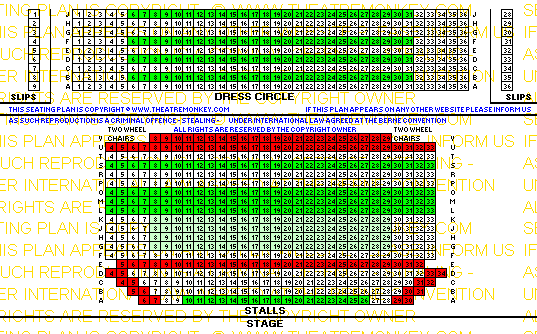
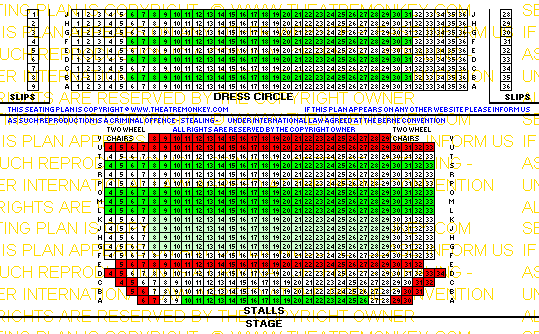
Based on paying FULL PRICE (no discount!) for tickets, site writers and contributing guests have ALSO created the colour-coded plans for "value for money," considering factors like views, comfort and value-for-money compared with other same-priced seats available.
For a full discussion, opinions, reviews, notes, tips, hints and advice on all the seats in this theatre, click on "BEST SEAT ADVICE" (on the left of your screen).
On the plans below:
Seats in GREEN many feel may offer either noticeable value, or something to compensate for a problem; for example, being a well-priced restricted view ticket. Any seats coloured LIGHT GREEN are sold at "premium" prices because the show producer thinks they are the best. The monkey says "you are only getting what you pay for" but uses this colour to highlight the ones it feels best at the price, and help everybody else find equally good seats nearby at lower prices.
Seats in WHITE, many feel, provided about what they pay for. Generally unremarkable.
Seats in RED are coloured to draw attention. Not necessarily to be avoided - maybe nothing specific is wrong with them, other than opinions that there are better seats at the same price. Other times there may be something to consider before buying – perhaps overpricing, obstructed views, less comfort etc.
Please remember that cheaper seats often do not offer the same view / location quality as top price ones, and that ticket prices are designed to reflect this difference.
By value for money:
Inter Alia
Hamlet
Some details will change, the monkey will update as available.

The Playboy of the Western World
Some details will change, the monkey will update as available.
By price:
Inter Alia
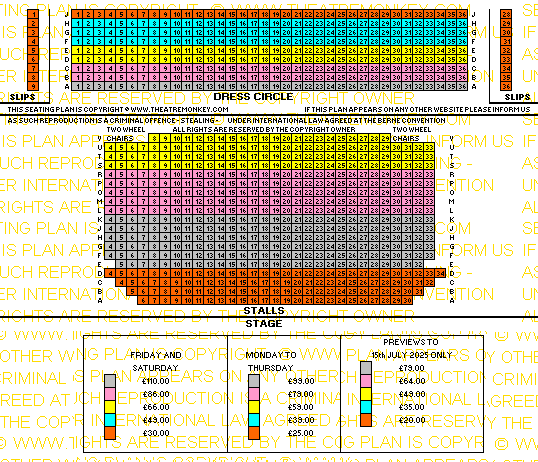
Hamlet
Some details will change, the monkey will update as available.

The Playboy of the Western World
Some details will change, the monkey will update as available.

Notes
Please note: The seating plans are not accurate representations of the auditorium. While we try to ensure they are as close to the actual theatre plan as possible we cannot guarantee they are a true representation. Customers with specific requirements are advised to discuss these with the theatre prior to booking to avoid any confusion.
-0.1144671, 51.5069049
Nearest underground station
Waterloo - Bakerloo Line (brown), Jubilee Line (silver gray), Northern Line (black). Also a main line station.
For mobility impaired audience members, the Society of London Theatre provide a "photo map" - illustrated walking route to this venue from a near landmark and also Waterloo Station (the nearest fully accessible station) on their website www.officiallondontheatre.co.uk, via the theatre's listing page on that site.
This station has multiple exits, not clearly marked, so be careful! The best route is as follows:
Turn left and head for the main exit - a grand archway with steps down to street level.
At street level, turn to your left, and walk towards the main road. Ahead to your left is a huge silver steel rectangle. No, the monkey does not know what it is either. To the left of it, and behind, is a pedestrian passageway called "Sutton Walk"; which goes under a bridge. Take it.
At the end is a fountain ahead of you. You are now on "Concert Road Approach". Turn to your left. The Royal Festival Hall is ahead of you. Walk towards it.
Facing it (note the cafe in front of you) - stand on this paved area (Belvedere Road) and turn to your right. A roadway and bridge are ahead of you. Cross the roadway, walk under the bridge.
On the other side of the bridge, the Royal National Theatre is ahead of you to the left. Also to your left is a roadway. Walk along it to the end.
Either use the revolving side door just before it to enter the coffee shop foyer, going straight on into the Lyttelton Foyer down some steps. OR, if this door is closed:
Turn right at the corner of the red building. Keep it to your right and go straight on.
There is a round sculpture to your left too.
The main theatre complex entrance is in the centre of the building, to your left.
The Lyttelton Theatre is at the ground level inside the building to the right.
___________
If you have the misfortune to leave the station by the "Waterloo Road" exit, fear not. You can either walk through Waterloo mainline station and leave by the York Road exit, or take this route - CONSIDER YOUR PERSONAL SAFETY.
On leaving the glass doors, turn left. Walk to the corner, and turn left into "Mepham Street". Walk all the way to the end of it, avoiding the temptation to go under any bridges.
At the end of the street is York Road. Cross it. Ahead of you, to the left, is "Sutton Walk", the pedestrian road under the bridge. Take it.
At the end is a fountain ahead of you. You are now on "Concert Road Approach". Turn to your left. The Royal Festival Hall is ahead of you. Walk towards it.
Facing it (note the cafe in front of you) - stand on this paved area (Belvedere Road) and turn to your right. A roadway and bridge are ahead of you. Cross the roadway, walk under the bridge.
On the other side of the bridge, the Royal National Theatre is ahead of you to the left. Also to your left is a roadway. Walk along it to the end.
Either use the revolving side door just before it to enter the coffee shop foyer, going straight on into the Lyttelton Foyer down some steps. OR, if this door is closed:
Turn right at the corner of the red building. Keep it to your right and go straight on.
There is a round sculpture to your left too.
The main theatre complex entrance is in the centre of the building, to your left.
The Lyttelton Theatre is at the ground level inside the building to the right.
_____________
Another visitor suggest this route: Take the tube to the Embankment station and walk across the Hungerford footbridge to the south bank, then walk past Festival Hall complex and under Waterloo Bridge.
The Royal National Theatre is ahead of you to the right.
Noted are the " Gorgeous views both up and down river on a good day or evening.". The monkey endorses this comment, especially at twilight!
Buses
1, 4, 68, X68, 168, 171, 176, 188, 501, 502, 513 to Waterloo Bridge.
Get off on the Bridge and look for the large advertising board on the roof of the National Theatre, facing the Thames. Take the stairs on this side of the bridge down to the ground. A safe crossing of the bridge can be made by taking the stairs down to first level and walking under it on a walkway linking the staircases either side of the bridge.
On the correct side staircase, leave it, turn to your right. The entrance is in the centre of the building, beyond the round sculpture ahead of you. The Lyttelton Theatre is at ground level inside the building to the left.
Taxi
A rank for Black taxis is at Waterloo Station - a fair distance from the theatre. Best chance of hailing one in the street is to walk on to Waterloo Bridge.
Car park
Under the theatre. Take the elevators in the centre of the car park to the correct level. Theatremonkey advises parking near the exit ramps for a fast getaway after the show, and strongly recommends you note the compass point, colour band and number of the nearest pillar you park by. Banquo's ghost has nothing on the haunted souls who wander the underground space, wailing for their transport each night. Some have been there since the place opened in the 1970's.


Legal
Social Media
© 2000-2025 "Theatremonkey," "Theatermonkey," "Chip" and "Sammy" are registered trademarks. Buy your tickets with confidence here. Theatremonkey is an Affiliate Member of STAR. All rights reserved.
Readers comments
"A25: "Great Britain" (August 2014). Got this through Entry Pass (for young people) for £5, so this felt like I had won the lottery. Cannot fault the view, not too far off to the side, eyeliner is pretty much at the level of the actors feet, and my feet had lots and lots of room to stretch out. Small speakers are in front of you but aren’t very loud so the sounds really good, and the actors obviously are heard crystal clear as they’re right in front of you."t;t;
"B4 and 5: "Travelling Light" (May 2012), (Chris B). On the end of the second row back (B4 is the aisle seat) and these seats feel more cramped with far less legroom than further back. There are no arm rests either so you feel very close to the people next to you. Coincidently arm rests start row E backwards. Personally I felt too close to the stage and as it such a wide stage you feel very distant from the left hand side. It's always nice to feel so close to the actors but a bit further back would appreciate the set a little better. However as the first few rows are the £12 seats you can't really complain."
"B10: (Mark). Fine. Apparently (for "Rocket to the Moon" in March 2011) you miss a bit of action in the corridor if you sit here for this show. I didn't feel it made a difference though.
"B27: Seat was great view wise. The comfort in the front rows of the National leave a lot to be desired."
"B27: "The Suicide" (March 2016). There's already a review of this seat which I totally agree with .. good view but an uncomfortable seat. The chairbacks are really low, zero legroom (even for me at 5'5") and no armrests but at £15 you cant really moan. Just two points though ..... there was one very visual joke in the play that, sitting in that seat, was totally lost as the view of it was obscured by the set and other actors in the way. Also, it was a signed performance and it struck me that, if you were relying on the subtitles, you'd need to sit in the back half of the stalls to stand any chance of reading the screens and watching the action at the same time?"
"C8: "Ma Rainey's Black Bottom" (March 2016). Got up close and friendly with people sitting next to me ... no arm rests so you are squashed together a bit. Zero leg room too, so I was thankful to only be 5' 5'' !! However .... view outstanding and for £15 an absolute billy bargain. Only downside was, because lots of the action takes place literally at the edge of the stage, with the actors spread the whole width across, I did feel a bit like I was at a tennis match."
"C17 and 18: "Absolute Hell" (March 2018). Having read your reviews we thought this was worth taking a chance on super cheap seats. How wrong we were! The seats are so narrow, I had my (larger than average size) neighbour sharing mine. There is also no rake, so if you have anyone tall in front of you, don’t expect to see very much. Luckily there were some free seats at the back so we were able to move for the second half."
C27, C26, C16: (Mark). Can't go wrong with row C of the Lyttelton at the price they are, Legroom tight as always but manageable."
"D27, D18, C9: (Mark). All excellent seats, although quite uncomfortable. For £10 (Or £5 Education Programme tickets) a steal!"
“Row E: Good seat, plenty of leg room."
"E9 and 10: “Habit of Art” ( November 2009). I would rate the seats green - a great view and close enough to hear every word the actors say, even when they are talking with their back to the audience."
"F25: (Mark – regular reader). On a £10 student standby! Very good clear view of the stage."
"G10: "One Man, Two Guvnors" (May 2011), (Taljaard – regular reader) Perfect view."
"J1: "Angels in America - part 1" (April 2017). Being quite tall it's not a usual problem for me, but there was somebody tall sat infront here and it did mean a bit of head bobbing at times since it was right in the centre of the stage. Good view of the stage though, the Lyttelton seats are rather uncomfortable generally."
"J14 to 16: "Much Ado About Nothing" (July 2022). We got quite last minute. Also good seats, very central. I took note of the comments about the wide stage and was glad that we weren’t any closer. Felt about right to be involved but not overwhelmed."
"J30 and 31: "Misterman" (May 2012), (Chris B). Comfortable seats with ample legroom, plenty close enough to make out actors facial expressions (or actor for Misterman) it is a very wide stage and the view is clear although you are much closer to the left side, the right does feel a little distant. I didn't feel you miss any of the left side either."
" K12 and K13 “The Pitmen Painters” (January 2009), (James – regular reader). Excellent seats, very comfortable with good legroom and a good rake. I would prefer to have been one or two rows further back as it’s quite a wide stage, but the view was very good from here in any case."
"K20 and K21: "One Man, Two Guv'nors" (June 2011). I do love a seat in the stalls! Excellent seats, (brown velour - did think of Theatremonkey, who I know has a chocolate fixation, only they weren't chocolate more kind of dairy milk). Good clear central view of all action on the stage and highly recommended. (Not as good as the New London Theatre seats for rake or view though!). Once again, the Monkey was involved in this transaction, as we had the choice of sitting in two rows, we opted for the row the Monkey said was 'green'."
"L7 and 8: "Last of the Haussmans" (July 2012), (Chris B). Good clear view of the stage with enough of a rake to see over the heads in front, you feel very close to the actors and can make out all facial expressions. Seats are comfortable with ample legroom. Wide armrests just about wide enough for two arms."
"L20: "London Tide" (April 2024). This seat is fine in terms of view but has the same problem as every seat in the stalls, at least - the back of the seat is a padded bar that sits against your lower back, so sitting back in your seat isn't really possible."
"M22: 'Season’s Greetings' (December 2010), (Clive). Excellent seat centrally situated with perfect view of the stage and good legroom."
"M32: “Ballyturk” (September 2014). Great seat. Thought I’d be miles from the stage but it didn’t feel that way. Could even see facial expressions pretty clearly from here."
"O 4 and 5: "Pinocchio" (December 2017). End of the row, a tiny corner of the stage obscured but nothing was missed. Legroom good and a good take meant that overall I felt they were good value. The one thing stopping complete comfort was the fact that I found the seats and the seat backs were a bit too low - however my more normal sized wife was very comfy. Overall, I was impressed."
"O16: "Here We Are" (May 2025). Oddly there is no offset between the seats in O and the row in front so a tall person in front could be a bit tricky, but it's a good view. For this production the stage covers roughly the central half of the full stage, so anyone in the front rows off to one side could end up feeling slightly left out of things, tough I don't think it would be enough to spoil the show."
"R16: (Hannah M). Has a very good view and leg room." ot;
"S10: Got for £10 on the day, was a great seat - could see everything."
"T33: (Clive) It felt a little remote from the stage but despite this was still a good view. Good legroom."
"V16 and 17: "Absolute Hell" (March 2018). Right at the back, but gave a good overall view of the stage."