
Royal Festival Hall
Southbank Centre, Belvedere Road, Lambeth, London SE1 8XX 020 3879 9555
- Where to buy tickets
- Best seat advice
- Seating plan/s
- Getting to the theatre
Buying tickets online
www.southbankcentre.co.uk the venue's own website provide the service.
This venue allows individual seat selection for most events.
Booking fees per transaction:
A £3 per transaction (not per ticket) fee is made.
Other Online Choices (with genuine S.T.A.R ticket agencies):
Independent S.T.A.R. ticket agencies may also offer an alternative choice of seats for some events. Details will appear here if appropriate.
Ticket agencies offer an alternative way to buy tickets, with booking fees differing from those charged by the venue box office itself. They may have seats available or special offers when theatres do not.
Ticket agency prices vary in response to venues implementing “dynamic pricing” - which alters prices according to demand for a particular performance. Current prices are advised at time of enquiry.
Box office information
Telephone: 020 3879 9555
Operated by the venue itself.
Booking fees per transaction for telephone bookings:
A fee of £3.50 per booking, is added to the total cost of tickets for telephone bookings. Cheaper to book online.
For personal callers or by post:
South Bank Centre Ticket Office, London, SE1 8XX
No booking fee for personal callers.
Special Access Needs Customers:
Wheelchair users and other registered disabled theatregoers can book their seats and enquire about concessionary prices that may be available to them on 020 3879 9555.
www.southbankcentre.co.uk is the official venue website.
Please remember that cheaper seats often do not offer the same view / location quality as top price ones, and that ticket prices are designed to reflect this difference.
- Choir
- Front Stalls
- Side Stalls
- Rear Stalls
- Balcony
- Boxes
Choir
Layout
Behind and above the stage, facing the rest of the auditorium.
These are sold for performances where the whole stage is not required - they can be removed when it is.
Seats in the centre block face the rest of the auditorium, those in the side blocks just face the stage from either side of the platform performing area.
Seating in all blocks is tiered.
All choir seating is above the platform area at the same level as the side stalls.
Legroom
Adequate for somebody of around 5ft 8 or so, but may be feeling tight for the taller. D11 and 12; 29 and 30, 55 and 56 and B54 all have nothing in front of them except aisles. The double seat spaces might be particularly suited to the larger person if they buy both tickets, feels the monkey.
Choosing seats in general
Seats in the centre blocks lose the view nearest part of the stage directly in front and below them. Seats in the side blocks lose the same - around 5% of the view, the monkey estimates, slightly more as you move towards the seats furthest from the front of the platform.
A12 and 55, B9 and 55, C10 and 57, D12 and 55 have a safety bar in view too, not a problem - but purists might want to know.
A wheelchair can be accommodated in row B, with a pretty decent view of the stage.
Theatremonkey chooses the side blocks of the choir first for feeling just that bit less exposed to public gaze! All seats are pretty good value, though, as they are normally very well priced.
General hazard notes
Seating is on benches without arm-rests.
Seat parts of each bench are padded, but the backrests are simple wood, sloped backwards at about a slight angle. May not be suitable for some with certain back conditions, the monkey felt.
Action happening directly in front and below seats will be missed.
Aisle end seats have safety rails in front.
Some may feel quite “exposed” sitting facing the rest of the audience.
Changes for the current production
None.
Front Stalls
Layout
The Stalls is divided into three sections by aisles.
There is a stepped rake of around four inches between all rows except A and B.
Legroom
Good in all seats for those up to around 6ft or so.
Row A has the most legroom, with nothing in front of it except the platform.
Choosing seats in general
Seats feel close to the stage.
For orchestral events, the conductor's podium is in front of central seats in row A - well, what do you expect at a concert!
For some more visual events the platform can be raised to improve sightlines.
Worth skipping if the concert is being amplified with speakers on the stage are A 5, 6, 38 and 39. The same goes for the same numbered seats in row B for this reason. These seats in rows A and B also happen to be closest to the exit doors.
Row B is on the same level as row A, making it worth skipping when priced the same, in the monkey view.
Those gripes over, choose seats 17 to 27 first, then the side section seats nearest the middle aisle to ensure best value and a central view.
The monkey would pick centre row G then F first, then G or F 12 to 16 or 28 to 32, then either E or D or even the rest of G and F then C or A depending on legroom required.
Alternatively, move up a price band to take from H to M centre then sides. Pretty much every seat has a good to excellent view, though - the monkey merely suggests things here as thoughts to consider.
Be aware of a sound desk behind centre row P.
General hazard notes
Conductors podium and speakers in view from row A and B seats.
Rows R to T seats 17 to 27 can be removed for a sound desk - worth avoiding P 17 to 27 if this happens, feels the monkey.
Changes for the current production
None.
Readers comments
“E34: "Slava's Snowshow" (December 2013). Sat in this seat for today's performance of Slava's Snow Show (great show!). Legroom excellent (I'm 5'6") and width of seat also generous. Comfortable seat but limited support for lower back. Sightlines were brilliant: the rake was steep enough to ensure that the heads in the row in front did not get in the way, and it was also easy to see between the heads. Could see 7/8ths of the main stage and into the wings on the opposite side from where I was sitting. Would happily sit here again."
"G26 and 27: "The Wizard of Oz" (July 2008). We sat in Row G seats 26 and 27 of the front stalls. It was actually the 4th row of seats and the sight lines were excellent as you are level with the stage. The leg room was good also. If I was buying tickets in the front stalls I would go for row G and back as before that you have to look up very slightly."
"N42 (Bob Pickett): The Royal Festival Hall must have the most comfortable seats in Theatre. Perfectly padded, lots of seat room, acres of legroom. N42 is right to the side, so you are looking across to the centre of the stage and to be honest this is about where you start losing facial details. But at the right price, I’d happily go for this seat again."
"P35: "The Light in the Piazza" (July 2019). Excellent view of the stage, although towards the back of the front stalls. Leg room was also excellent. The ticket cost me £25.00 on Today Tix, a site I would strongly recommend for other theatre goers. The original cost of this seat was £65.00, hence I received a good deal. At all times the voices on stage could be heard very clearly."
Side Stalls
Layout
Formerly known as the "Annex."
Four long rows to the side and slightly above the front stalls, extending from row T to the start of the choir area a few metres beyond the edge of the platform.
Rows W to Y are tiered from a level floor at the height of rear stalls row AA.
Row Z is behind the other three rows, slightly elevated and requiring stairs to access it from row AA level.
Row W seats 1 to 4 and 30 to 33 are single seats placed one behind the other, facing the stage at an angle.
Row W seats 5 to 17 and 34 to 46 and row X 11 to 17 and 40 to 46 are all angled to face the stage, with X on a raised plinth.
Row Y 19 to 27 and 47 to 56 is raised above row X, but seats in this row, as well as the same numbered seating in W and X, face the platform sideways on with no angle to them.
Legroom
Just adequate in most seats for all but the tallest over 5ft 10 or so. Row Z has considerably less - 5ft 6 maximum.
In row W seats 19 to 27 and 47 to 56 and Z 16 to 27 and 45 to 56, architecture means that legroom diminishes as you get further along the row towards the stage.
The final seats in row W have significantly less legroom - probably uncomfortable for those above 5ft 7 or so in the monkey view.
Choosing seats in general
This section of seating lose around a tenth of the view of the platform area nearest to them due to the angle of the seating and safety rails.
For symphonic concerts of course any loss of view is not important to most, but for more visual events the monkey would probably skip the seats closest to the stage.
It would always take seats furthest from the stage first, as they have the best viewing angle.
Single seats W seats 1 to 4 and 30 to 33 are a decent pick if available, simply for peace as much as view.
Wheelchair spaces can replace W seats 1 to 4 and 30 to 33. These provide an OK view, but chair users should take the places in rear stalls row AA first, in the monkey view.
Row W 23 to 27 and 52 to 56 are cramped, avoid if tall.
Row Z is in its own section behind the other three rows. All seats are in a single row, with those furthest from the stage having an angled view, those closer facing the stage. The pillars in this row do not affect the view from any seat that the monkey noticed. This row is set back a little way, though, and the seats nearest the stage from around 21 to 27 and 50 to 56 lose up to a quarter of the platform from view – make these a final choice.
General hazard notes
Rails and seat angles deduct 10% of the stage view from most seats.
Rows W and Z have wide wooden safety rails in front of them, slightly intruding into the view of seats closest to the stage.
One reader wasn't crazy about the sound at a 2012 concert here.
Changes for the current production
None.
Readers comments
"RR 28 and 29: Just wanted to let you know that we went to a Philharmonia concert last night (13th December 2012) and started in RR 28 and 29. These are centre of the auditorium but quite far back. Visuals were fine with the caveats that have been noted on your site. But the sound was TERRIBLE. It was very heavily bass and muddy. But coughs from people under the overhang were louder than the orchestra in even medium sound passages. We moved at the intermission and the second half was like being in a different concert. And we were on the extreme right of the auditorium in KK. My advice to anyone who cares about sound quality is they should avoid any of the seats from LL back underneath the overhang from the seats above you. We have been to any number of concerts in the top level and found the sound just fine."
"Y52: My view was severely restricted by the balcony railing, as was that of everyone in my row and those in the row in front. I feel that all these seats should be marked in red on your website."
Rear Stalls
Layout
Formerly known as the "Terrace."
This is stepped area rising from an aisle behind the front stalls to the rear of the auditorium.
The Balcony overhangs these seats at row DD but doesn't affect the view of the top of the performing area.
Seating is split into middle and two side blocks by aisles.
Row AA is split from the main section of seating by a wall and rail between it and row BB. It sits on the wide aisle that divides the stalls from the rear stalls.
Legroom
Good in all seats for those up to around 6ft tall, felt the monkey, with the exception of row BB which has a little less.
Row AA has most legroom as the wide aisle has nothing in front of any seat.
Choosing seats in general
Central section seats AA 15 to 25 may have a problem with visual events as a sound desk could be in front of them, as could safety rails ahead of them, right behind front stalls row T. These bars are high and intrude noticeably into the view. Row BB 21 to 31 may also be worth skipping in this event.
The side sections of row AA are mostly used to provide the best wheelchair viewing places - chair users should enjoy these, the monkey feels. They are also closest to the exit doors.
Seating in rows BB to XX is not "offset" - seats are directly behind each other, but the steep rake should mean few viewing problems over those ahead, feels the monkey. One reader found that they really were not staggered enough, though, and advised caution if booking here for a visual performance.
For visual performances where sightlines are important (not orchestral concerts usually) the monkey felt that row BB's rail could be an issue for shorter people.
Further, again for visual performances only when the stage might be framed by an arch at the sides, seats 1 to 4 and 48 to 51 in rows BB to XX may not have quite as good a view, being to the sides of the auditorium and outside the line of the sides of the stage area.
At all performances with all seats at the same price, the monkey would pick row FF 15 to 37 first, then work backwards to row LL taking either 15 to 37 or side block 7 to 14 or 38 to 45 for preference. The rest of these seats are at least fair value, the monkey felt.
Rows SS back may feel a little further from the stage for visual performances - though the view should improve if the stage is raised - but for classical concerts this won't worry anyone, the monkey feels.
Extra wheelchair places are available in row XX in the centre block. The monkey would take row AA places, then side stalls and box places before these, just for proximity to the stage - though anyone sat here will enjoy at least a fair view.
Rear stalls standing areas behind row XX offer a fair view of the stage.
General hazard notes
Seating is not “off set” to see between seats in front.
Row AA may have a rail in view.
Central rows AA and BB may have a sound desk in view.
Row BB may have a rail in view for the shortest.
Changes for the current production
None.
Readers comments
BB4: "The Light In The Piazza" (June 2019). The legroom is excellent…the safety rail would really only affect those well under 5' tall. It gets a red coding on your seating plan, but as a tall chap who needs plenty of space, I would rate it 5 stars (even if it's a little far back)."
"JJ19: Decent legroom. However, quite far from stage. Seats aren’t staggered so large, and the rake not particularly steep, so parts of the stage are blocked by (the many) heads in front. Not recommended if going to something that is quite visual."
"KK 31 and 32: "The John Wilson Orchestra." Because, as mentioned on your website, the seats are not staggered - my wife and I ( I'm almost 6ft ) had great difficulty seeing the singers on the stage and we noticed that many people around were having the same problem swinging their heads from side to side straining to obtain a clear viewing line.
Although the seats are raked they are not raked sufficiently and I would suggest that potential patrons proceed with caution when considering purchasing seats in the central rear stall area for any concert involving soloists or singers who they might actually want to see.
I believe that paying patrons should be warned of the limitations of these seats before purchasing the same.
I have made this point to the Festival Hall but had a generally unhelpful response."
"TT 15 and 16: "The Light In The Piazza" (June 2019). Almost at the back of the rear stalls. I’m 6ft 1in, my partner 5ft 4in. The view of the stage for this theatrical production was not particularly good for either of us. Aside from the real issue of seeing round people in at least the two rows in front, the foreground beyond was a sea of heads. I don’t think the view improved substantially until half way down the rear stalls, say around row MM. It seems clear that other people had a similar problem. Even before the show started people were moving to unoccupied seats. At the interval there many more people sought another seat.
So, in summary, seats in the rear half of rear stalls at the Royal Festival Hall may be fine when you don’t need to see things on stage to appreciate the performance but they are not good when it’s a theatrical production."
Balcony
Layout
Formerly known as the "Grand Tier."
This is split into front and rear sections by a broad aisle between rows B and C.
Rows A and B are split by walls into sections like boxes containing sixteen seats arranged (mostly) in blocks of eight.
Rows C to N are normal long rows of seats, split into five sections by aisles.
Legroom
Just acceptable in all seats except row B where it is noticeably far less, and C where it is tending to tight too.
Row A perhaps has an inch or so more legroom.
The monkey urges the taller to take front or rear stalls first if comfort is a priority.
Choosing seats in general
The view from all seats can be distant for visual performances, but the sound is adequate for orchestral ones.
The monkey would probably pick the non-restricted view seats in row A first, avoid row B and C, then go for seats as near the front and central as possible, avoiding the rail intrusions if the event is a visual one. For orchestral ones it would just pick seats near the front.
In rows A and B, seats 2 to 4 and 45 to 47 suffer the boxes intruding into the view slightly, the monkey noted - which might be a bother for events more visual than a simple orchestral recital. B 4 and 49 are closest for a quick exit.
Similarly, the view from seats 4, 5, 12, 13, 20, 21, 28, 29, 36, 37, 44 and 45 are also affected by high safety bars at the ends of the aisles.
The aisle bars in front of row A may also affect the view from some seats in rows C to F (the monkey noted it does in 20,21, 32 and 33, but suspects more) at some performances when the stage height is low. If raised (for visual events rather than simple orchestral concerts) this situation should be alleviated, especially with the stage at maximum 7ft height, but the monkey couldn't test that at this stage and would welcome reader feedback.
A safety rail in front of row C may block the view for some shorter visitors at all performances.
Rows C to E seats 1 to 3 and 50 to 51 are to the sides of the hall and the monkey feels them worth missing for visual events where a central view is preferable.
Aisle seats in row N (except 4 and 49) are closest to doors for a quick exit. Claustrophobics might want to avoid rows F to N seats 4 and 49 as there is no aisle beside them.
General hazard notes
Rows A and B 2 to 4 and 45 to 47 have boxes in view. Seats 4, 5, 12, 13, 20, 21, 28, 29, 36, 37, 44 and 45, and row C also have a rail in view.
Sightlines decline if a low stage is used (the stage height varies by event).
Rows F to N seats 4 and 49 have no aisle beside them.
Changes for the current production
None.
Readers comments
"Rows A and B: (Alan Marshall). [Commenting before the refurbishment]. We go to the Festival Hall fairly regularly and go for seats in the Grand Tier/Balcony (rows A and B). Safety bars do obscure the view in some seats - try to avoid aisle seats. It is true that the tickets are sometimes marked to show a "restricted view" but prices are not reduced on these seats.(Invaluable advice, thinks the monkey, who feels it still applies to a great extent).”
Boxes
Layout
Arranged on four levels in the walls beside the front stalls area and above the side stalls to just beyond the front of the platform.
Each box contains 4 movable red chairs (up to 16 in the Goodman box only).
All except the Goodman box are angled towards the stage.
The Goodman box has a side view with the wall not angled.
Legroom
Good in all boxes.
Choosing seats in general
A rail runs around the front of each box.. A good sideways views of the stage is possible from them all, though the shortest might find the rail at the front of the box a slight issue.
The monkey notes that sightlines alter depending on the height of the stage for each performance.
A reader feels that the lowest boxes have the best views of the stage.
Boxes 3 and 31 can take a wheelchair, and are worth taking once row AA places have gone, in the monkey view.
General hazard notes
Rail at the front of each box.
Views are side on to the stage.
Sightlines may be affected by changes in stage height.
Changes for the current production
None.
Readers comments
“Box 8: The rail is quite a nuisance. With the stage at such a steep angle below, to see over it you have to lean right forward. If you sit back and relax, the view is through the rails.
For a classical orchestra with no amplification, the sound was still excellent. But for amplified performances with speakers directed at the main auditorium I wonder if the sound might not be so good. Also, the seats are not nearly as comfortable as in the main auditorium.
At the end of the performance we did try the view from the bottom row of boxes (box 5). There the rails did not get in the way of the view to the stage. We intend to check this properly at some future concert. The seats may not be so comfortable, but it’s still quite fun to have your own little space."
Notes best seat advice
Total 2788 seats.
Air conditioned auditorium. this is underneath the seating, so don't place coats there if possible.
Infrared headsets and loop available, guide dogs welcome. All documents available in large print. Wheelchair access available to all levels via ramps and lifts to decent seats in auditorium. Wheelchair places are in boxes 3 and 31, choir row B, side stalls row W and rear stalls rows AA and XX. Adapted toilets are available on ground and first floor levels within the main toilets. Dedicated help is available on 020 3879 9555, and an "access list" can also be joined on this number, which helps members gain concession priced tickets for visits.
Toilets on levels 2 to 6; level 2: 2 ladies 6 cubicles and 5 cubicles respectively, 2 gents 4 cubicles / 3 cubicles. Level 3: 2 ladies 8 cubicles / 6 cubicles, 2 gents 3 cubicles in each. Level 4: 1 ladies 3 cubicles, 1 gents 2 cubicles. Level 5: ladies total 10 cubicles, gents total 9 cubicles, 1 disabled cubicle in each. Level 6: ladies total 5 cubicles, gents total 5 cubicles, 1 disabled cubicle. 3 ladies, 3 gents and 3 unisex facilities are also available by the roof pavilions on level 6. Small toilets for children are available on the "Spirit Level" of the Hall, and baby changing facilities are also available here, on level 2 and within the Southbank Centre Square lobby near the glass lift. Some restaurants on the site also offer baby changing facilities too.
Cafés, Restaurants, Art Galleries and open foyer performance spaces are offered in this complex. A singing glass elevator connects all levels... yes, it does...
General price band information
Theatres use "dynamic pricing." Seat prices change according to demand for a particular performance. Prices below were compiled as booking originally opened. Current prices are advised at time of enquiry.
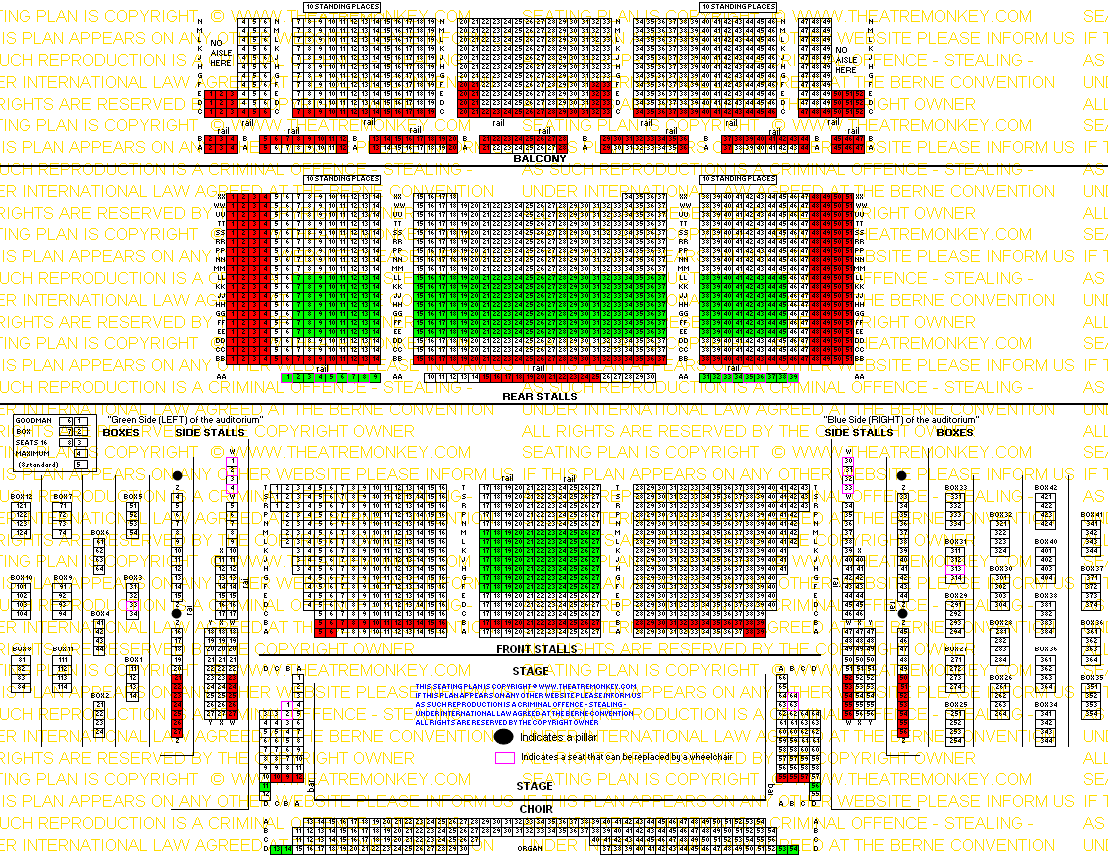
Based on paying FULL PRICE (no discount!) for tickets, site writers and contributing guests have ALSO created the colour-coded plans for "value for money," considering factors like views, comfort and value-for-money compared with other same-priced seats available.
For a full discussion, opinions, reviews, notes, tips, hints and advice on all the seats in this theatre, click on "BEST SEAT ADVICE" (on the left of your screen).
On the plans below:
Seats in GREEN many feel may offer either noticeable value, or something to compensate for a problem; for example, being a well-priced restricted view ticket. Any seats coloured LIGHT GREEN are sold at "premium" prices because the show producer thinks they are the best. The monkey says "you are only getting what you pay for" but uses this colour to highlight the ones it feels best at the price, and help everybody else find equally good seats nearby at lower prices.
Seats in WHITE, many feel, provided about what they pay for. Generally unremarkable.
Seats in RED are coloured to draw attention. Not necessarily to be avoided - maybe nothing specific is wrong with them, other than opinions that there are better seats at the same price. Other times there may be something to consider before buying – perhaps overpricing, obstructed views, less comfort etc.
Please remember that cheaper seats often do not offer the same view / location quality as top price ones, and that ticket prices are designed to reflect this difference.
CLICK SEATING PLAN TO ENLARGE IF REQUIRED. USE "BACK" BUTTON TO RETURN.
By value for money:
-0.1188175, 51.5058095
Nearest underground station
Waterloo - Bakerloo Line (brown), Jubilee Line (silver gray), Northern Line (black). Also a main line station.
This station has multiple exits, not clearly marked, so be careful!
Turn left and head for the main exit - a grand archway with steps down to street level.
At street level, turn to your left, and walk towards the main road. Ahead to your left is a huge silver steel rectangle. No, the monkey does not know what it is either. To the left of it, and behind, is a pedestrian passageway called "Sutton Walk"; which goes under a bridge. Take it, at the end is a fountain ahead of you.
You are now on "Concert Road Approach". Turn to your left. The Royal Festival Hall is ahead of you. Walk towards it. Go to the right hand side of it.
You are now in an area of grey concrete. The Festival Hall is to your right, a mass of balconies with open space below them to your left. On one of the balconies, words spell out the Queen Elizabeth Hall and Purcell Room.
Walk up the centre of this area. You can either turn to your left and use the side entrance doors to the hall - about a third of the way along the street, or walk to the end of the area and turn left. The main Festival Hall entrances are to the left of you!
____________
If you have the misfortune to leave the station by the "Waterloo Road" exit, fear not. You can either walk through Waterloo mainline station, leaving by the York Road exit OR use the route below - BE AWARE OF YOUR PERSONAL SAFETY if you do, though.
On leaving the glass doors, turn left. Walk to the corner, and turn left into "Mepham Street". Walk all the way to the end of it, avoiding the temptation to go under any bridges.
At the end of the street is York Road. Cross it. Ahead of you, to the left, is "Sutton Walk", the pedestrian road under the bridge. Take it.
At the end is a fountain ahead of you. You are now on "Concert Road Approach". Turn to your left. The Royal Festival Hall is ahead of you. Walk towards it. Go to the right hand side of it.
You are now in an area of grey concrete. The Festival Hall is to your right, a mass of balconies with open space below them to your left. On one of the balconies, words spell out the Queen Elizabeth Hall and Purcell Room.
Walk up the centre of this area. You can either turn to your left and use the side entrance doors to the hall - about a third of the way along the street, or walk to the end of the area and turn left. The main Festival Hall entrances are to the left of you!
_____________
Another visitor suggest this route: Take the tube to the Embankment station and walk across the Hungerford footbridge to the south bank, then walk to the Festival Hall complex.
Noted are the "Gorgeous views both up and down river on a good day or evening.". The monkey endorses this comment, especially at twilight!
Buses
1, 4, 68, X68, 168, 171, 176, 188, 501, 502, 513 to Waterloo Bridge.
Get off on the Bridge and look for the triangular neon sculpture on the roof of the Hayward Gallery, and the glass front of the Festival Hall. Take the stairs on this side of the bridge down to the ground. A safe crossing of this bridge can be made by taking the stairs down to first level and walking under it on a walkway linking the staircases either side of the bridge.
On the correct side staircase, leave it, turn to your left and walk along the river front to the Festival Hall on your right past the ugly underground wasted space (used as a skate park by children).
Taxi
A rank for Black taxis is at Waterloo Station. Or best chance of hailing one in the street is on Waterloo Bridge.
Car park
Belvedere Road or The Hayward, both just next to the Festival Hall. Follow signs to the left as you leave the car park. Take the stairs to the left up to the first level, turn left at the top, you will be facing the side of the Festival Hall. Follow the walkway around the side of the building. The Hayward Gallery is ahead of you. If you see a railway bridge with pathways leading under it, wrong way.
Remember to get your ticket validated at the venue box office for a discounted parking rate in these car parks.


Legal
Social Media
© 2000-2025 "Theatremonkey," "Theatermonkey," "Chip" and "Sammy" are registered trademarks. Buy your tickets with confidence here. Theatremonkey is an Affiliate Member of STAR. All rights reserved.
Readers comments
“Choir: The choir is often an excellent place to sit (after all, how many people can actually tell if their stereo speakers are reversed?) but less so for piano concertos because the lid deflects the sound away from you. (This comment was made pre-refurbishment, but little has changed, editor).